
5 Trailblazing Women Who Shaped Chattanooga's History
It wouldn’t be National Women’s History Month without celebrating the remarkable women who have profoundly influenced Chattanooga’s story over the past century and beyond. Many are honored through local landmarks. Discover their inspiring legacies below, along with ways to learn more.
What other Chattanooga women deserve recognition? Share in the comments.
Dr. Mary Edwards Walker
 Dr. Mary Edwards Walker was a trailblazing surgeon, alleged spy, abolitionist, feminist, and the only woman ever awarded the Medal of Honor. Born in Oswego, New York, her connection to Chattanooga stems from the Civil War’s Battles of Chattanooga. Known for her distinctive top hat on battlefields—signaling her neutrality—she overcame immense challenges. Her Medal of Honor was controversially revoked in 1917 by President Woodrow Wilson, as she never formally served in the military, but President Jimmy Carter reinstated it in 1977.
Explore her full story at the National Medal of Honor Heritage Center.
Mary Hardway Walker
In 1917, at age 69, Mary Hardway Walker moved to Chattanooga with her family. Born into slavery in 1848 and freed at 15, she worked diverse jobs like babysitting, cleaning, and housekeeping. Remarkably, in 1963—at 115—she enrolled in the Chattanooga Area Literacy Movement, learning to read, write, and basic math two nights a week. She passed in 1969, but her determination endures as proof that age is no barrier to pursuing dreams.
Her legacy lives on at the local retirement home named after her at 2501 Market St., and in the 2017 children’s book The Oldest Student: How Mary Walker Learned to Read by Rita Lorraine Hubbard.
Ruth Holmberg
 Ruth Sulzberger Holmberg, born March 12, 1921, in New York City, called Chattanooga home from 1946 until her death in 2017. As publisher of The Chattanooga Times—owned by her family alongside The New York Times—from 1964 to 1992, she championed civil rights, school integration, and environmental causes. Her philanthropy continues to impact arts and education.
Landmarks like the Holmberg Bridge to Bluff View Arts District, the gold-domed Chattanooga Times headquarters at 735 Georgia Avenue, and the Mizpah Congregation synagogue on McCallie Avenue (gifted by her grandfather Adolf Ochs) bear her influence.
Ruby Lambert
 Ruby Lambert inspired Chattanooga’s iconic Ruby Falls. As teens in Indiana, she and Leo Lambert fell in love; he followed her to Chattanooga. Their romance culminated in an extraordinary wedding gift: Ruby Falls itself. In the 1920s, amid railroad expansion, Leo’s team drilled from Lookout Mountain’s summit, accidentally discovering the cave—home to the tallest and deepest underground waterfall open to the public—through a single crack in the limestone.
This fateful find created a timeless attraction.
Bessie Smith
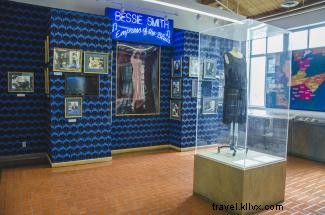 Chattanooga’s “Empress of the Blues,” Bessie Smith, born here in 1892, rose from street performances in the Big 9/MLK area with her brother Andrew to stardom. Her 1923 recording of “Downhearted Blues” in Philadelphia launched her career; she became the highest-paid Black entertainer of her era after marrying Jack Gee.
Visit The Bessie Smith Cultural Center for exhibits preserving African American history and culture in Chattanooga.
Chattanooga brims with history, much tied to these iconic women. Explore more in our guide to Women-Owned Businesses to Support in Chattanooga!