Navigating Skye's Rugged Crossings & Scenic Circumnavigations
Stumbling in the half light on boulders, numb fingers clawing at wet neoprene I swore and shivered into dry clothes before laughing with the mild hysteria that accompanies such moments. I turned to Tim – teetering on weed-covered rocks at the edge of Loch Snizort, engrossed in his own private struggle for dry warmth – and looked out over the wild expanse we had just crossed, the last of three crossings on a long day during our journey around the Isle of Skye.
Open crossings were an obvious challenge for the earliest recreational sea kayakers; it was Franz Romer who made the first recorded crossing of the Atlantic in 1928. The great circumnavigations came later: Geoffrey Hunter made the first attempt to paddle around the UK mainland in 1970, and in 1977, along with Nigel Foster, was the first to circumnavigate Iceland.
Paul Caffyn and Nigel Dennis made the first complete circumnavigation of the UK in 1980. Just two years later Caffyn completed what remains one of the greatest solo journeys ever undertaken in a sea kayak, his Dreamtime Voyage – the circumnavigation of Australia.
Requiring extraordinary commitment, such trips remain the exception. Yet the circumnavigation of any island requiring more than two or three days on the water offers the same focus, the same simplicity of purpose that sets such journeys apart from others. The Isle of Skye is such an island.
I first came to Skye as a climber completing long routes on the Cuillin’s vast gabbro walls, traversing the ridge in sections many times over, and it was here that the notion of sea kayaking took hold. A decade later, with heavily laden boats, Tim and I launched at Armadale just as the afternoon’s rain gave way to blue skies and a brisk westerly. Very quickly we turned the first major headland of the trip, the Point of Sleat. Conditions were lively, with a long swell of around 1.5m colliding with the cliffs, and for a short stretch the sea was frantic, heaving and breaking from all directions.
Cold, wet and tired we landed beneath clearing skies and cooked in the last of the day’s light, stretching tired limbs as yet unused to the dead weight of loaded boats. We had packed enough food for eight days but planned to complete the trip in six. It meant covering an average of 46km a day and we set off prepared for days much longer. Already we had a 15km shortfall to make up.
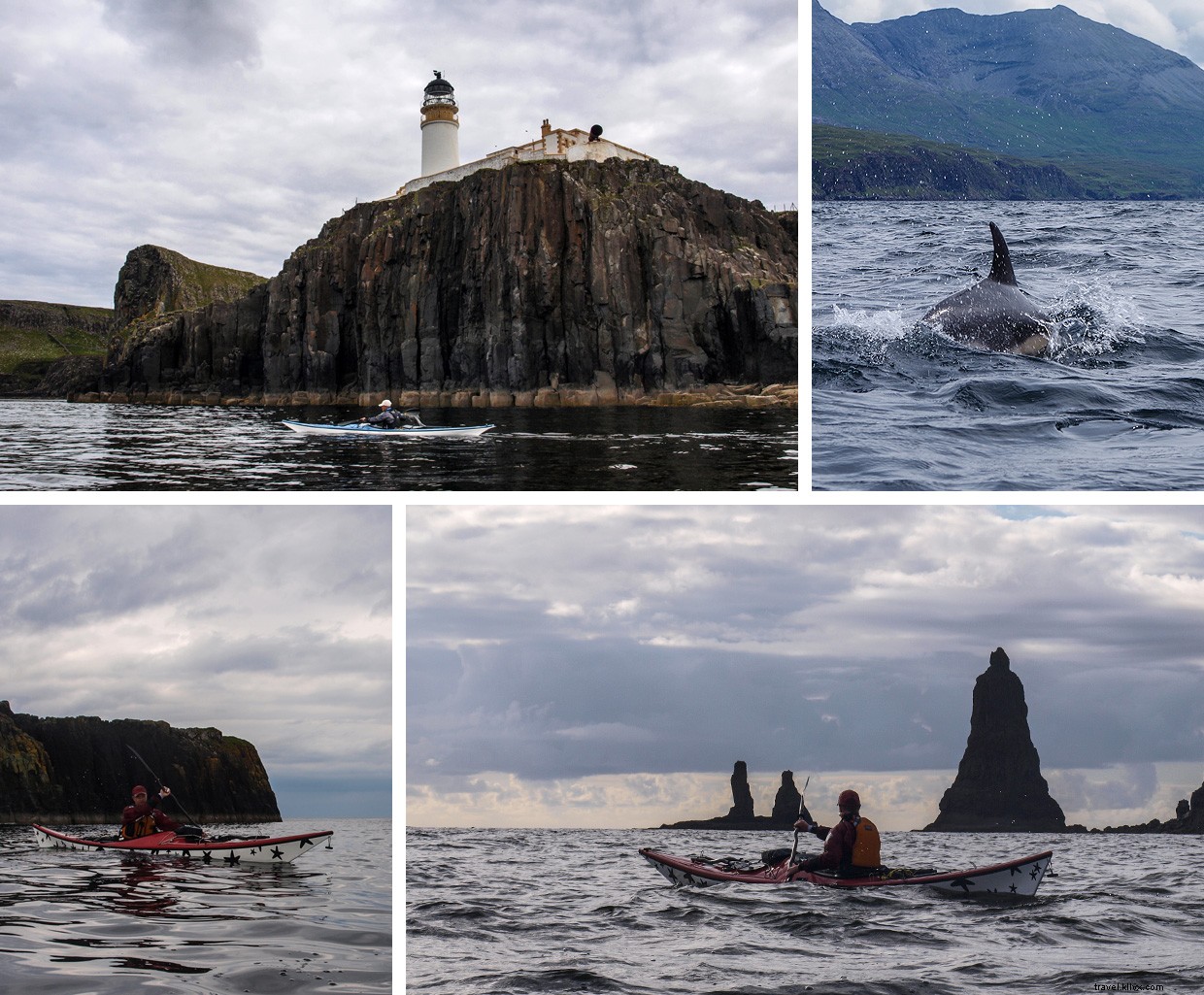
It was a late start on the second day. Such is the way of things on these trips: it takes a day or two to settle into the routine, establishing systems for managing gear, cooking and living on the coast. It is what I love about such journeys; life is simple, every action has purpose, and economy of effort becomes a matter of pride. Then there are moments of sheer indulgence, watching the sun set behind distant mountains as the tide creeps across empty sands, timeless and perfect in their simplicity.
Passing Loch Eynort, I enjoyed our proximity to the coast after the crossings of the previous day, conscious there would be many more. This is one of the attractions of paddling around Skye – unless one has unlimited time to complete the trip, a number of not insignificant crossings are inevitable. Yet there are also many long stretches where it is possible to explore the dramatic coastline without compromising the objective for any single day.
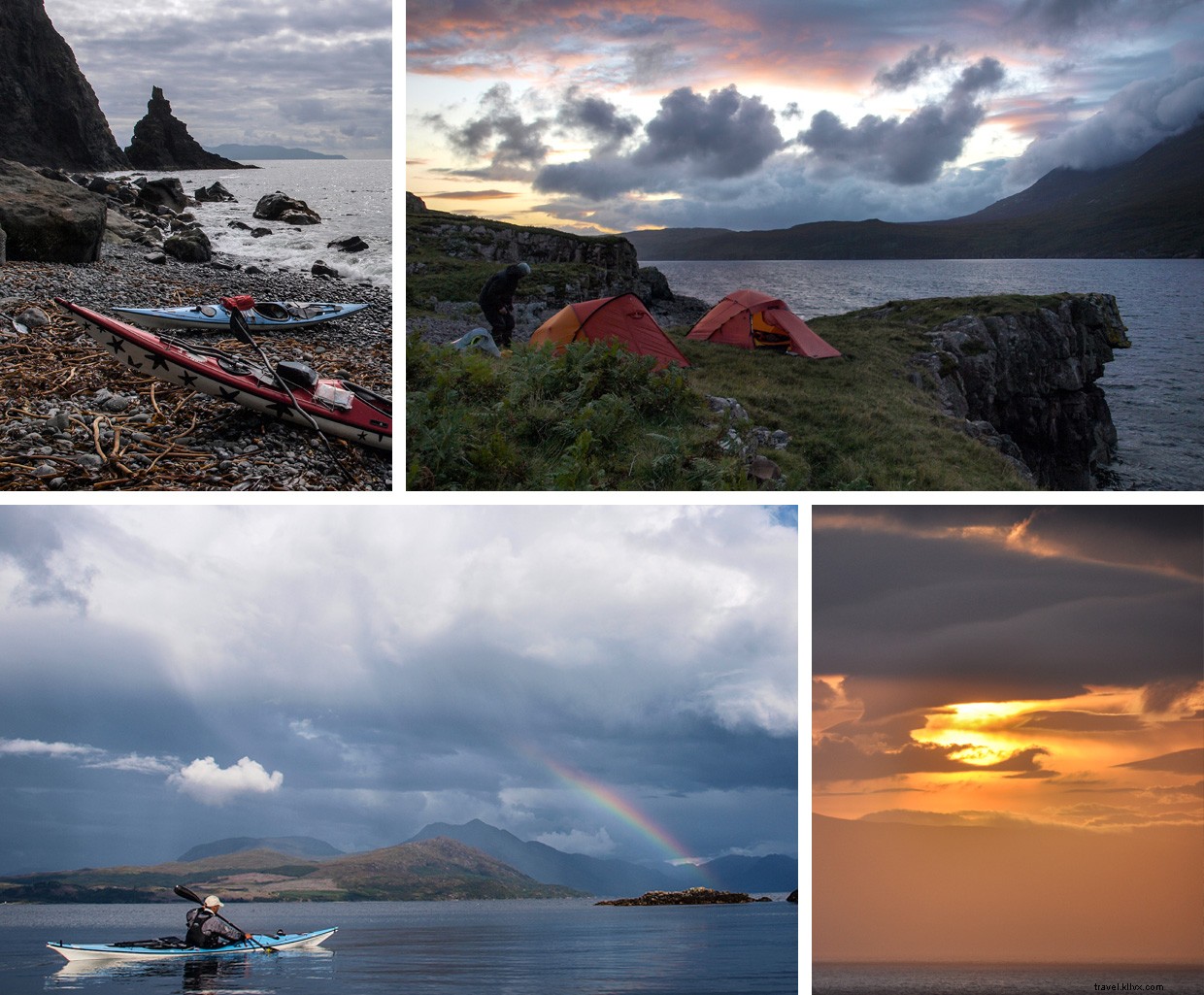
It is something I have often pondered when paddling these open coastlines exposed to the swells. It is not just their size or rugged appearance, but something less tangible that creates a sense of witnessing a landscape from a different era. Broken stacks of fractured rock and great walls tower like giants not yet fully formed over the infinite age and power of the ocean. Sitting in contemplation several kilometres off shore, the stacks known as Macleod’s Maidens beckoned, drawing us towards Skye’s most remote and rugged coastline. Here, huge cliffs, caves and arches dominate, waterfalls cascading through hidden geos. Some we entered and many others we passed, torn between the desire to explore this phenomenal architecture and the need to reach Lorgill Bay and our camp. On trips such as these, the greater objective is never far from one’s mind. Once again it was dark by the time the tents were up.
Waking early, I lay still, listening. The tent hung wet and heavy with the dew. Below, the tide rose with slick lethargy, an oily calm beneath heavy skies, as yet undecided what to do with the day. I dressed quickly, put on water for a brew, and rolled the sleeping mat before sorting snacks for the day ahead. We broke camp, one eye on the boats’ rapidly filling hatches, the other on the horizon, watching for subtle signals that would tell of changing conditions.
The crux of Skye’s west coast is without doubt rounding Neist Point. Here, strong tidal flows often combine with the swell to create conditions most kayakers would rather watch from the cliffs above. Glassy seas had left us with a sense of anticlimax as we rounded Neist Point, yet the calm provided us with an opportunity to put all but one of the major obstacles behind us. We set the day’s objective with little discussion. Somewhere along the way, the winds gathered, imperceptibly at first but soon enough the boats were pitching into steep seas, the spray flying, and our gentle day became a gruelling slog.
Headwinds are just another part of sea kayaking, dealing with them just another skill to learn. When the seas are big the wind itself is often less noticeable; perhaps it’s the adrenaline, the concentration required in big water, or perhaps the wind shadows of larger waves shield the paddler as they slip between them. But relatively flat seas, with short steep waves created by strong offshore winds, are another matter entirely. Too small to offer any escape from the constant buffeting, salt spray stings the face while the boat stalls in every trough. It’s tiring, relentless work and one must find a pace that can be held without pause until shelter is found.
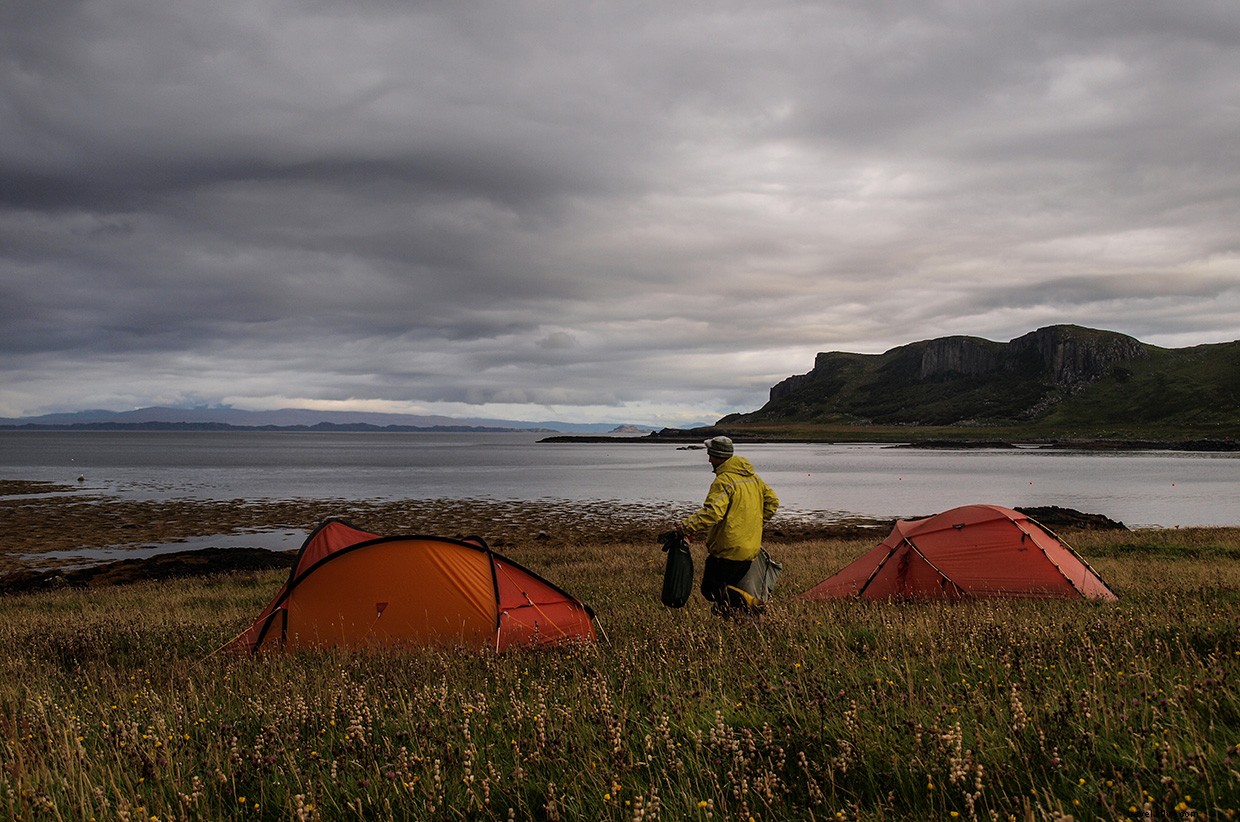
Once again we settled into a rhythm, each locked in our own thoughts and our own cadence as the last crossing of the day drew slowly to a close. Passing together beneath the dark bulk of Ru Idrigill we landed on the weed-covered foreshore as the rain began to fall. Tomorrow, if the weather was good, we would round Rubha Hunish, the northernmost headland of Skye; but all thoughts of paddling slipped from my mind as I settled into the dry warmth of a down bag. The call of the gulls was the last sound from the sea.
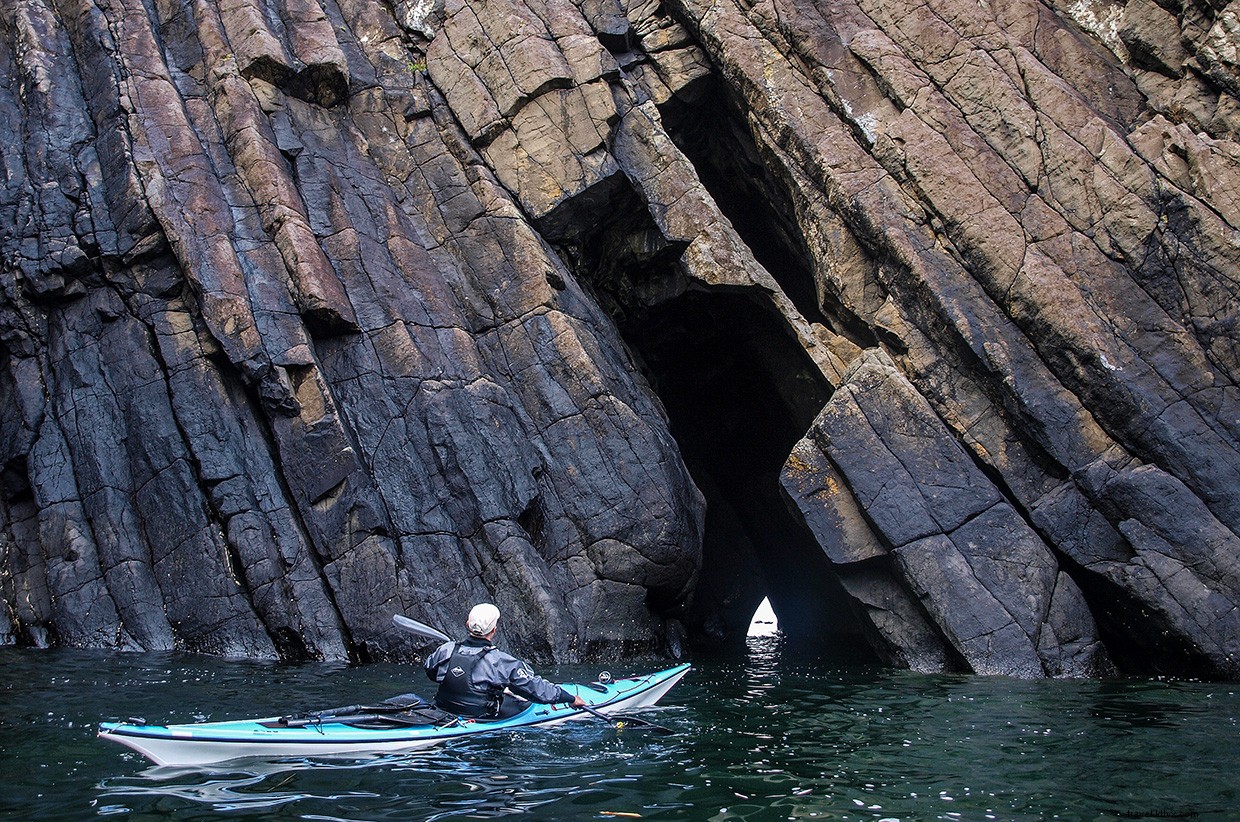
As headlands go, Rubha Hunish has something of a reputation, but I was focused on the swirling tidal eddies beneath the cliffs and completely unprepared for what happened next. Two fins, then three; the first impossibly tall, sleek and black. Orcas. A female and her calf, escorted by the bull, his dorsal fin reaching high above the swell. We watched in awe as the small pod travelled quickly out into the Minch. Elated, we picked up the pace, paddling close in beneath cliffs and stacks, into deep geos and through dark caves.
The days that followed saw us camped on Staffin Island amidst long grasses and wildflowers, looking out towards the mountains of Torridon, resting on stony beaches as sea eagles soared overhead and packing in frantic haste as the midges swarmed on the last morning. From azure skies, the sun danced on sparkling waves, the wind slowly easing to leave oily seas. Throughout, the sense of urgency remained. With every obstacle passed, thoughts turned quickly to the next – the next headland, tidal flows, and of course the wind. Successful circumnavigations depend on state of mind and a strategic approach as well as, at times, sheer bloody-mindedness when conditions get rough.
We approached Armadale and the beach we had left six days before. The mountains of Knoydart aflame in the late evening sun, we landed side by side, stepping from the boats with relief, satisfaction and no small sense of sadness at the journey’s end.