Exploring Baffin Island: Arctic Extremes and Spectacular Cliffs
Organising an expedition trip to Baffin island isn’t straightforward, especially one that depends on self-sufficiency for 30 days’ camping on the sea ice, with the horrific dangers of the winter arctic temperatures, and the ever-present threat of polar bear attack. After two years and many long hours researching, planning and discussing an expedition itinerary with its relative wonders and dangers, there were still lingering doubts. The reality of what we were about to under take suddenly hit home hard with fear and apprehension threatening to derail the trip before it had even started. It took another week of processing the emotional commitment of such a trip before the flights were actually booked.
Stepping out of the small ten-seater plane in the small North Eastern settlement of Clyde River was the second reality check. It’s hard to imagine such a barren, monotone-white landscape where no contrast between the sky and land exists. Being so close to the North Pole our compass would be redundant: if we were to lose our bearings here, it would be game-over for us. The extreme arctic cold takes hold immediately threatening to freeze the very air already warming in the windpipe leaving you gasping for breath as you quickly try to cover any exposed skin for protection. We were to pay the price painfully to the cold for our first mistake. Wearing our expedition boots on the journey meant that we were unconsciously sweating into the liners. Within minutes of touching down in Baffin our feet froze with frightening speed leaving our toes feeling hard and dead like frozen sausages. Managing and checking our extremities for cold injuries and frostbite was to become a daily routine from the start. This frozen feeling was to become a constant, niggling concern – any injury would not only create a rescue drama but would end the trip immediately. Marcus joked that squeezing our feet into ski boots was too much like giving them their own little coffins, but even that did little to ease the tension.
 Our first day on the island was spent buying last minute previsions and looking around the small Clyde community to get a sense of how things worked. The few wooden houses of the town were set out in the stereotypical North American grid pattern, and several porches acted as cold storage with seals stashed in rows or polar bear pelts drying on frames. The whole place had a wild, frontier feel to it that exacerbated the sense that we were definitely foreigners in a strange and bewildering landscape. We soon attracted the attention of the local children who took great pleasure in staring, pulling faces and giggling before engaging in a game of tag. Word of the outsiders in town quickly spread and within a day our kit with ourselves were packed into the back of a Komatic and leaving for the frozen Ocean and Fjords we had come to explore.
Our driver, Ilko, was a man in his late 60’s, and from a bygone arctic era. Living with his family in a tiny, remote settlement to the north of Clyde River until he was 26 years old. There he survived solely by hunting the wildlife, living in perfect harmony and respect of nature’s rhythms. IIko displayed the calm confidence of a man who knew how to take care of himself in a wilderness few would ever experience, even within Clyde itself. He was an elder whose words and opinions carried a lot of weight in the community. There was a wise and rare spiritual quality to IIko that settled any nerves or doubts amongst the team as he nodded with approval at our itinerary. We hung achingly onto every one of his words, repeating the advise to ourselves to ensure its memory storage in case it would be needed later.
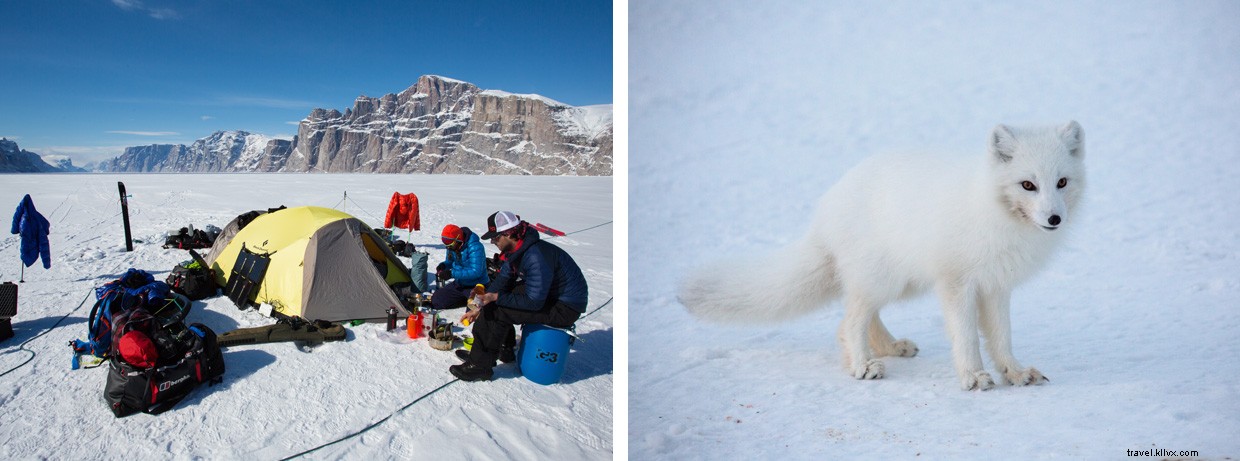
As we headed north across the mouth of Sam Ford Fiord, we found a dead seal pup at a breathing hole that was still warm. It was an polar bear kill and the bear had only just taken a bite before being scared off by the noise of our approaching skidoos. The Inuits joked that we might be lucky because at least the bear was no longer hungry as they stowed the dead seal for their dinner. A pep talk later on in the journey on what not to do in a polar bear attack bought home the shocking revelation that in spite of having a .308 rifle and a pump-action shotgun with magnum shells, the likelihood of us surviving such an attack was minimal. For the first few days camped out on the ice the fear was oppressive as it played tricks with our minds. The silence of the barren landscape was deafening and disconcerting as we looked for early warning signals to any approaching danger. Every lump and bump in the distant ice morphed into a mirage of an approaching bear that we had to check and recheck down the scope of the gun. We rigged a perimeter rope connected to an air horn around the tent as an early warning system in the hope it would give us time to act if the worst happened. It was amazing how such a flimsy system settled the nerves enough to justify sleep. After a few days our confidence grew and in spite of signs of life on our daily excursion we soon found the worry reduced enough to enjoy and appreciate the incredible and unique beauty of our surroundings. Yet the apprehension lingered on in the back of our minds.
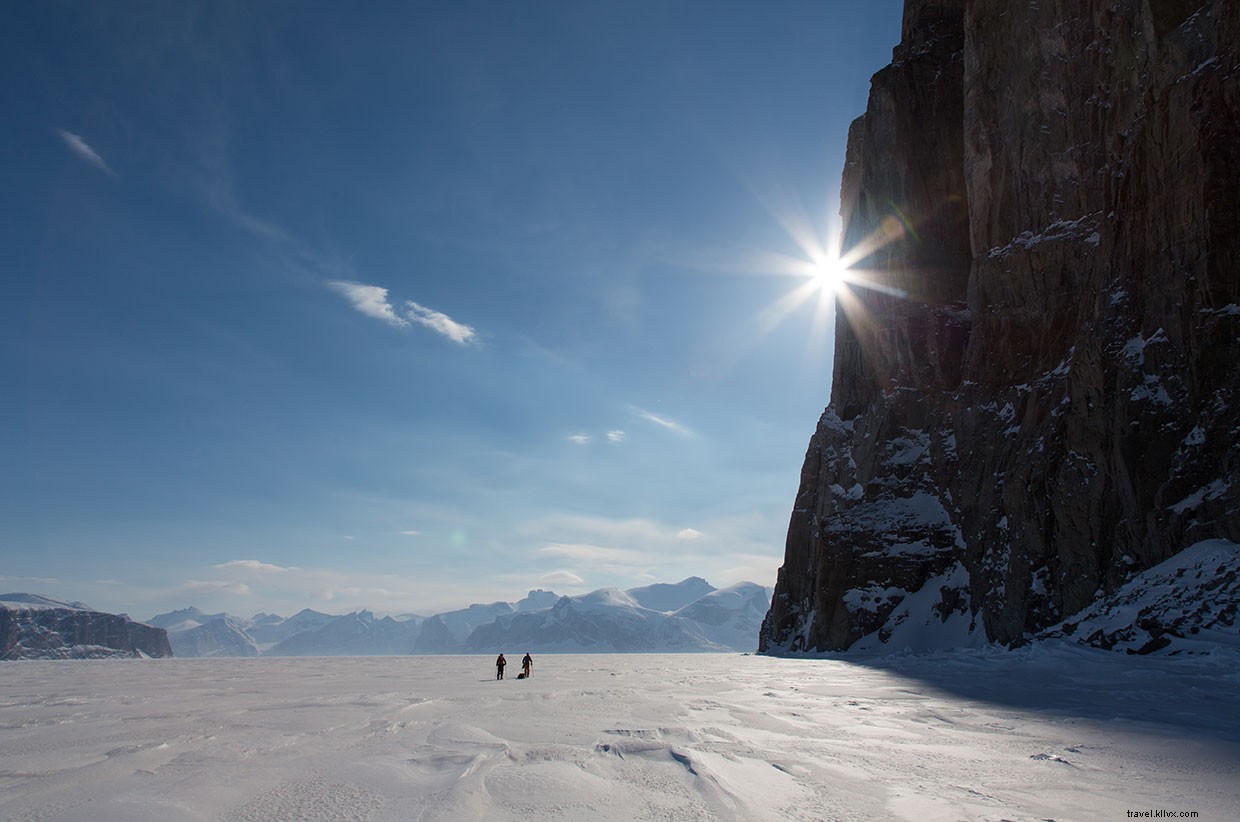 We were woken on our first morning camped on the ice by a strong, gusting wind through the fiord as it rippled the tent material loudly, it was too cold to get up straight way and so we continued to snuggle into the warmth of our sleeping bags until the sun rose high enough to provide sufficient heat for it to be bearable to move. We had planned to travel some 20km by kites around Scott Island to explore some of the ski potential on this opposing rock island as it jutted vertically straight out of the sea ice. I had to learn about kite skiing very quickly before the other two more experienced kiters left me behind. I had briefly flown a kite before, but in the preceding two months there hadn’t been a gust of wind to speak of to be able to get out and practice. The fear of not being in control, tied to a kite at the mercy of the wind’s power to do what I thought could be its upmost damage saw me kicking my heals as we packed our day bags. I spent the first morning hoping the wind would soon die and we would all be forced to rely on the relative comfort of shuffling across the ice on skis. Unfortunately that didn’t happen and with a kite the size of a handkerchief and a gentle breeze I soon got the hang of things. In fact I soon became to love the potential that kiting opened up to our adventure potential. We could travel for miles across the flat sea ice, towing our whole camp on sledges, to explore new areas easily in a matter of hours instead of days. The exhilaration of being propelled forward by the kite would induce an adrenaline induced high akin to accelerating in a sports car with the roof down. It soon became a tough choice between a freeform kite session on the ice and exploring powered filled couloirs to ski.
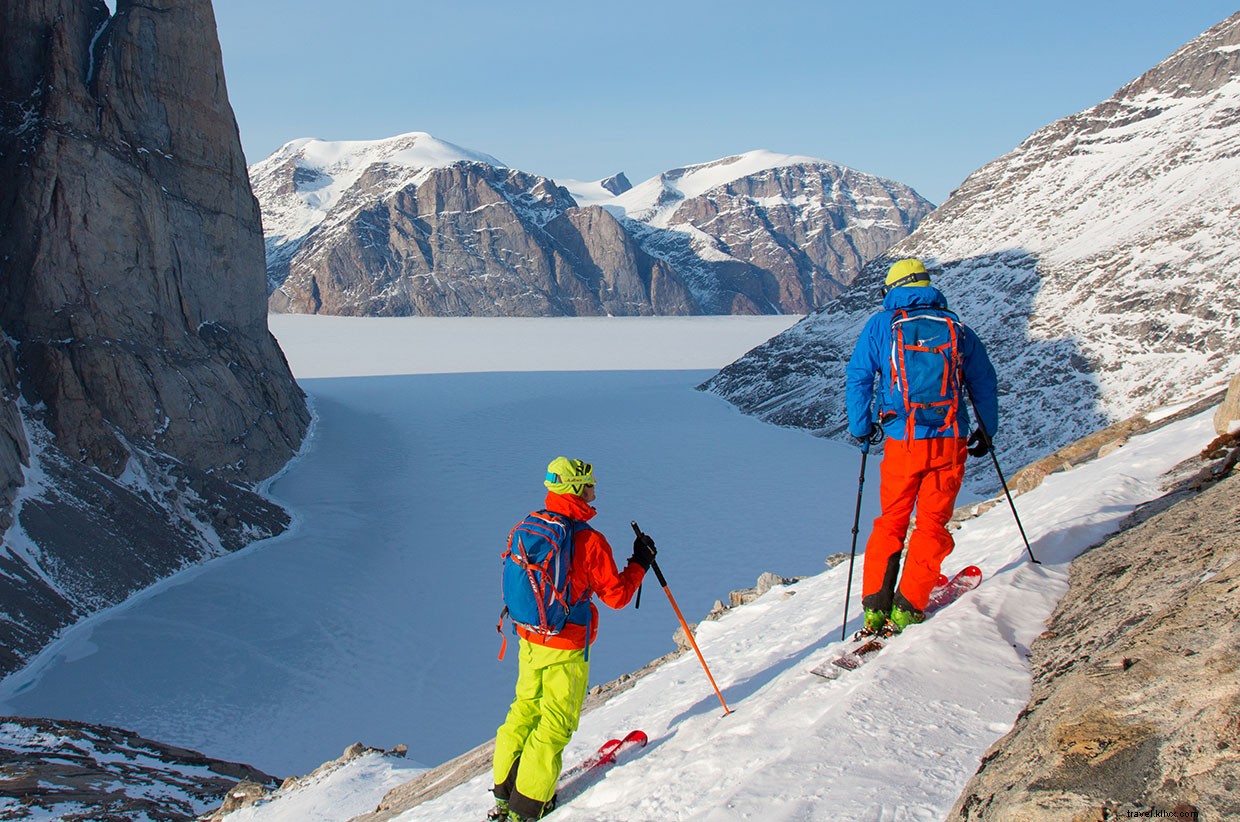
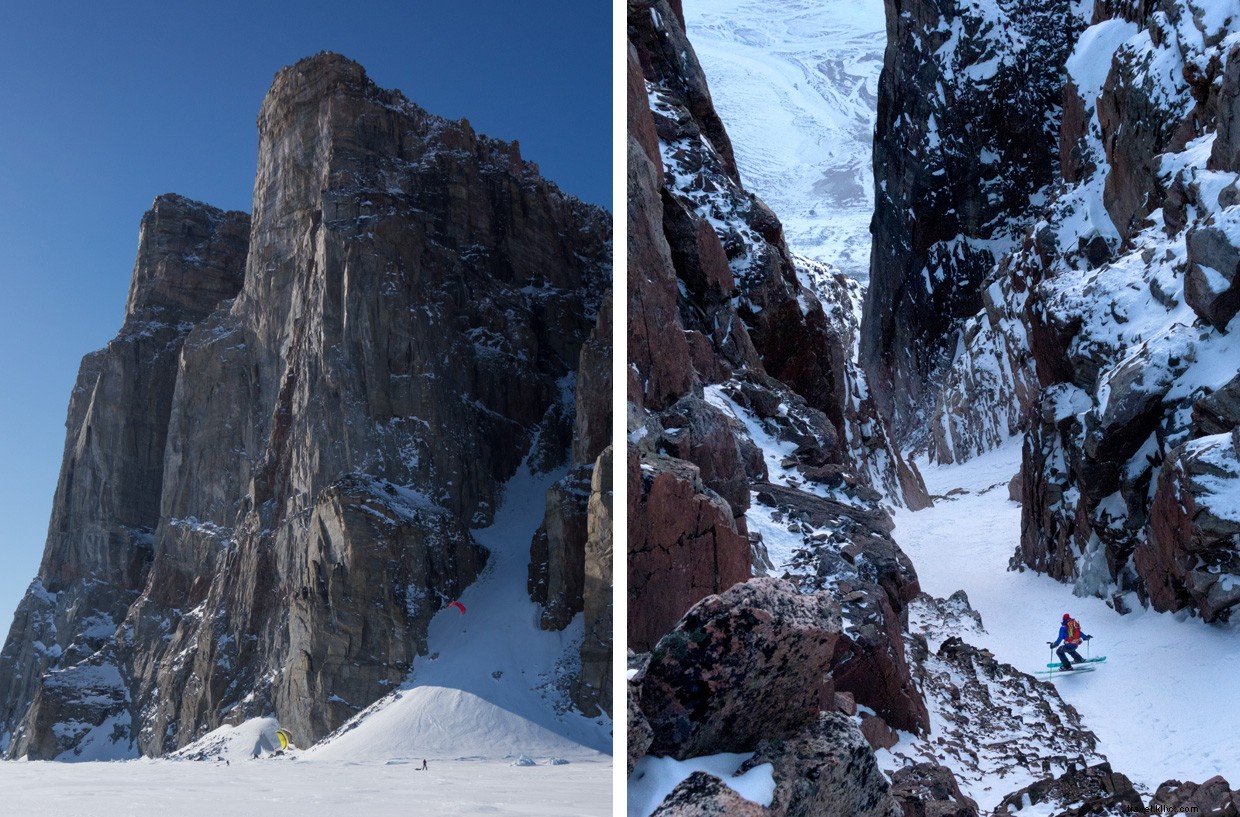
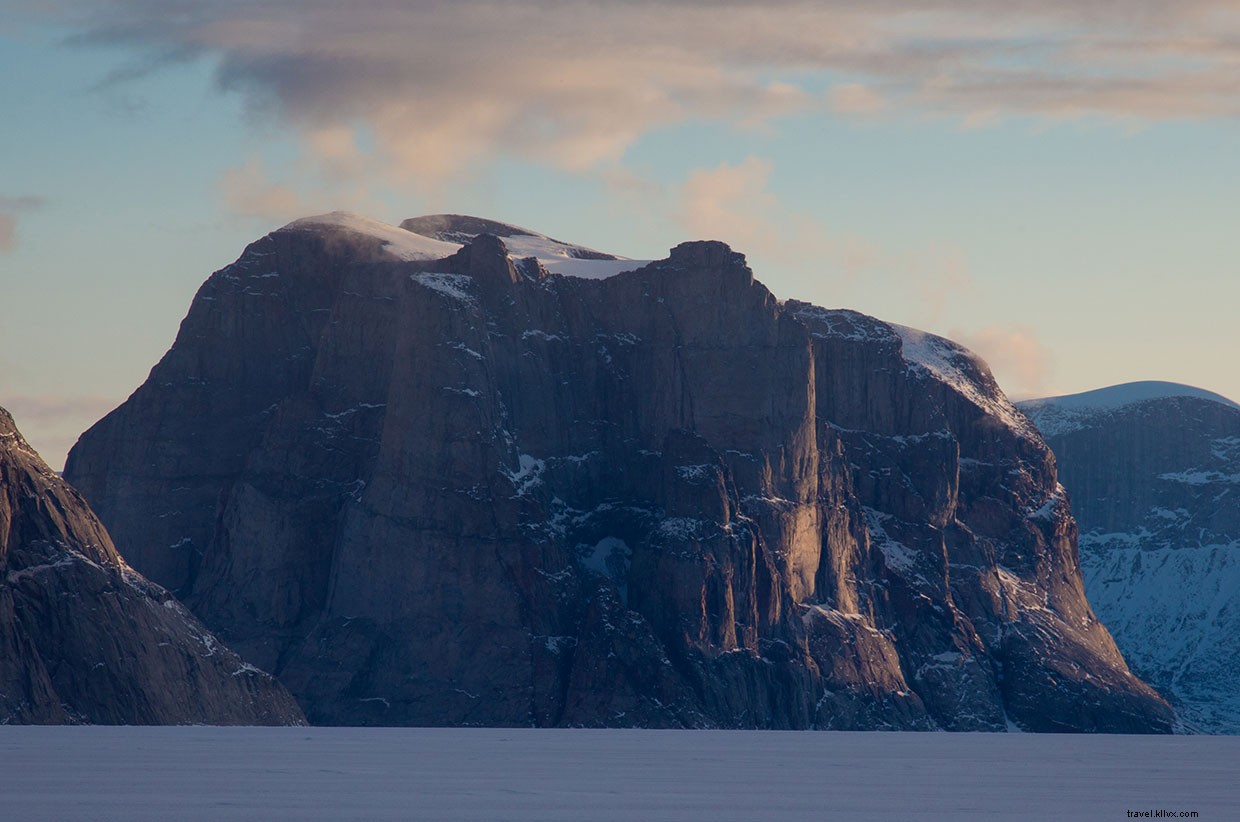
From our initial camp by Scott Island we moved some 40km deeper into the Fiords towards the increasingly enticing call of the enormous cliffs of Gibbs Fiord that we had spotted days before. As we kited into the Fiord the steep cliffs that looked a few hundred feet high from a distance started to grow into huge imposing, ancient, immense acres of impeccable, vertical rock thousands of feet high. We were left speechless, unable to comprehend the scale and beauty in front of us. Weirdly, it felt like there was an unseen energy coming off the rocks themselves that no matter how many times we took a photo we failed to capture what was really there. We would often catch ourselves just standing in silence staring across the Fiord trying to permanently imprint the view and feeling in our minds. A strange unbreakable bond with the frozen landscape and it’s hardy, ingenious inhabitants (both human and animal) was poignantly growing in all of us.
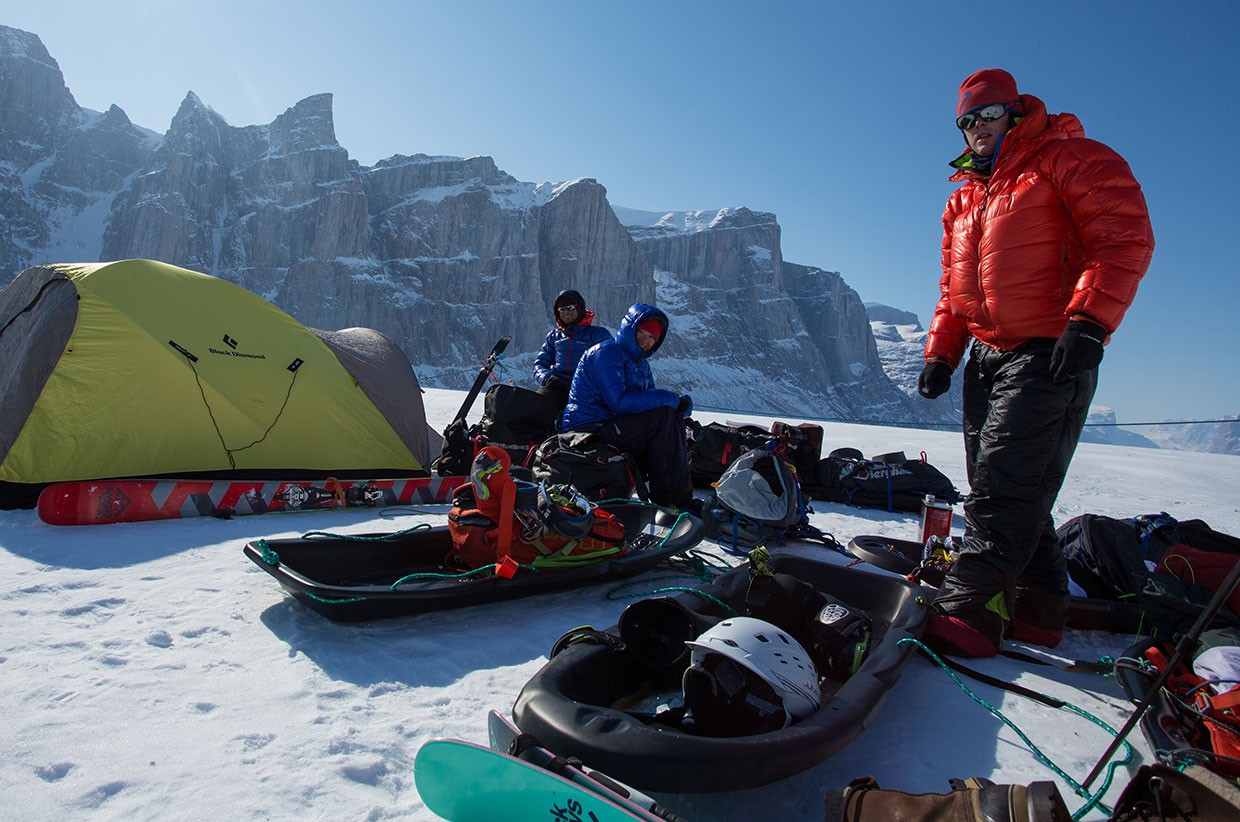
By now we had settled nicely into a routine aligned to the rise and fall of the sun and its welcomed warmth. Apart from regularly seeing various paw prints from wolves, foxes, and bears there was no obvious signs of life that we complacently started to feel that we were truly alone. Then, one night we were all fast asleep, exhausted from the day’s adventure, when the spine chilling screech of the bear alarm cut through the eerie silence like a car crash right through the tent wall. We sat bolt upright, trying to make sense of where we were and what had just happened, frozen in position, our hearts beat loudly in our own ears. After what seemed like too long Marcus whispered quietly, ‘put your head out of the tent and take a look’. ‘No way,’ I said, fear raising the pitch of my voice. ‘Okay, we both do it together,’ Marcus suggested.
 We cautiously undid the tent zip and poked the guns out first, and then with a big breath we stuck our heads out ready to face the predator we believed to be out there. Silence. We look around, guns still loaded and ready. Nothing. The wind must have triggered the alarm as the rope hung loose around our tent. False alarm. We all breathed a sigh of relief. We didn’t manage to get back to sleep that night as fear turned to laughter at each other’s fright responses.
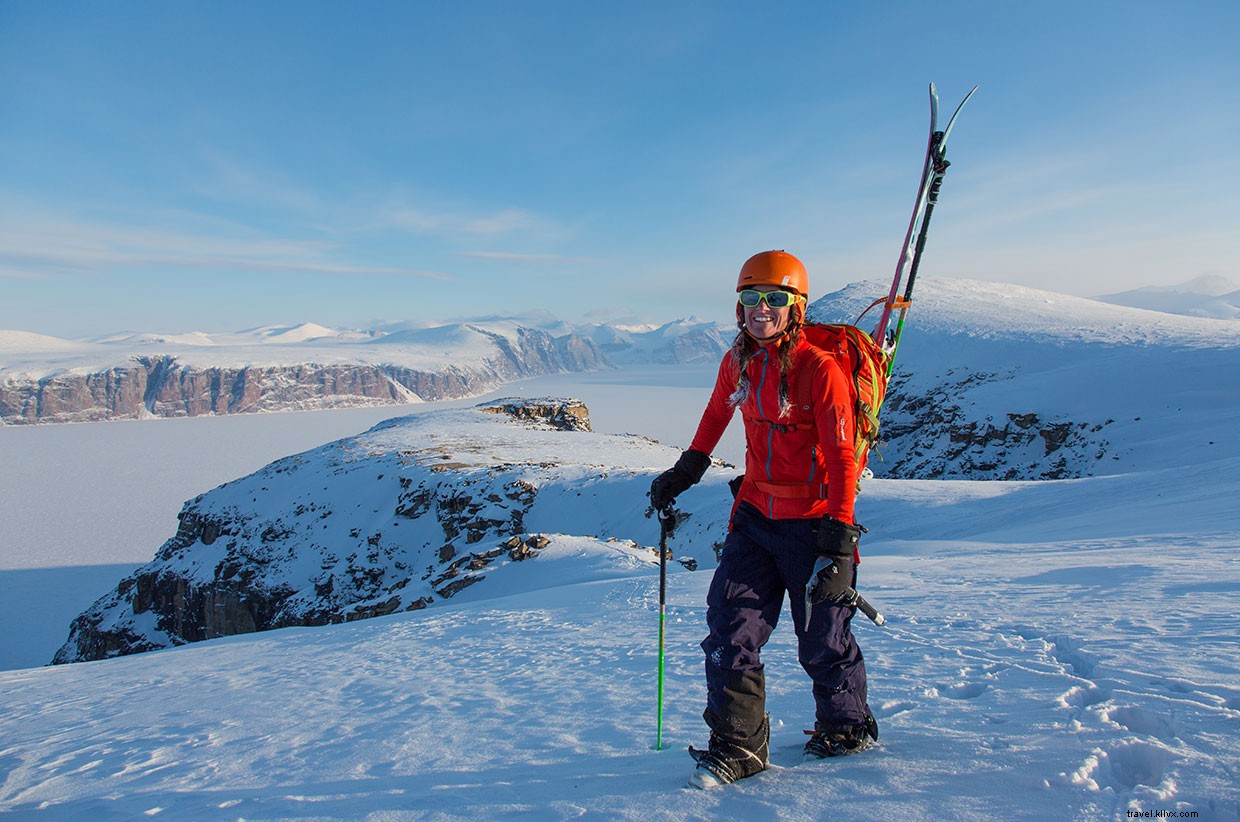
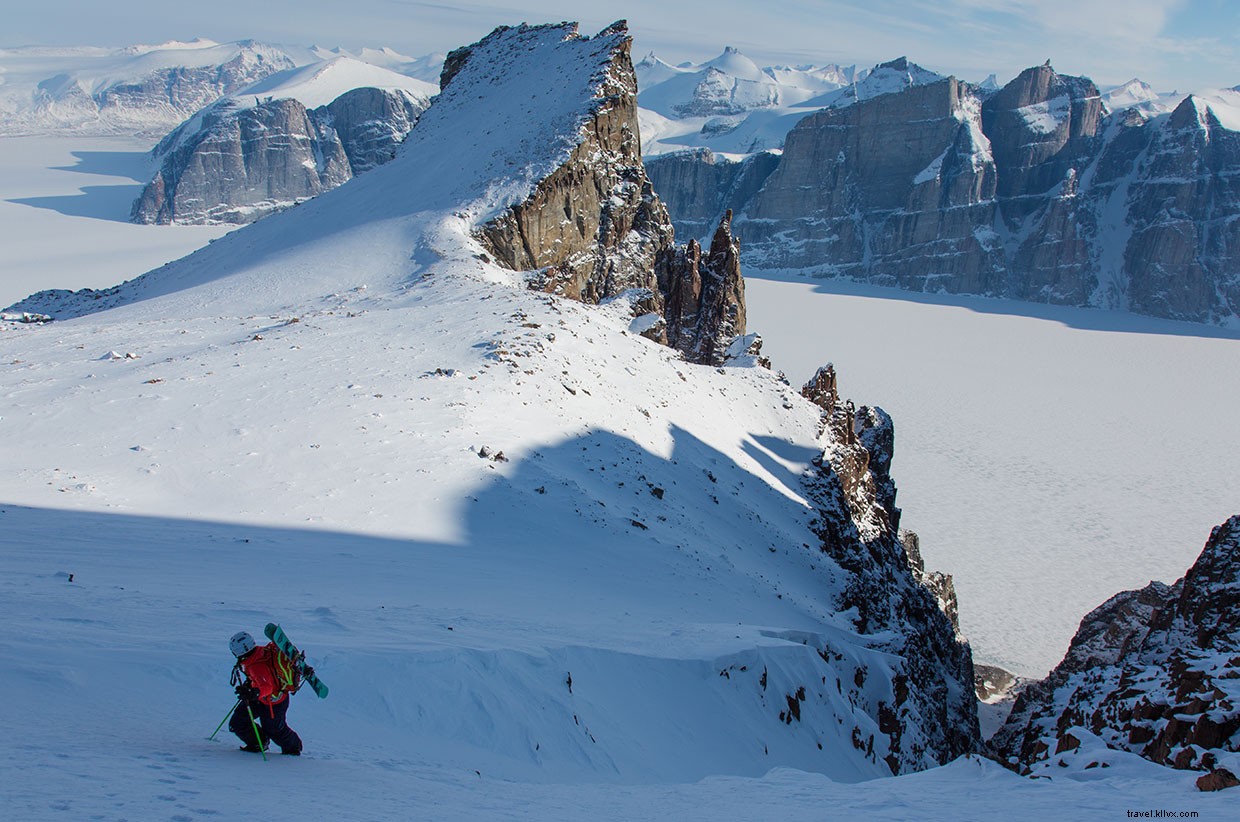
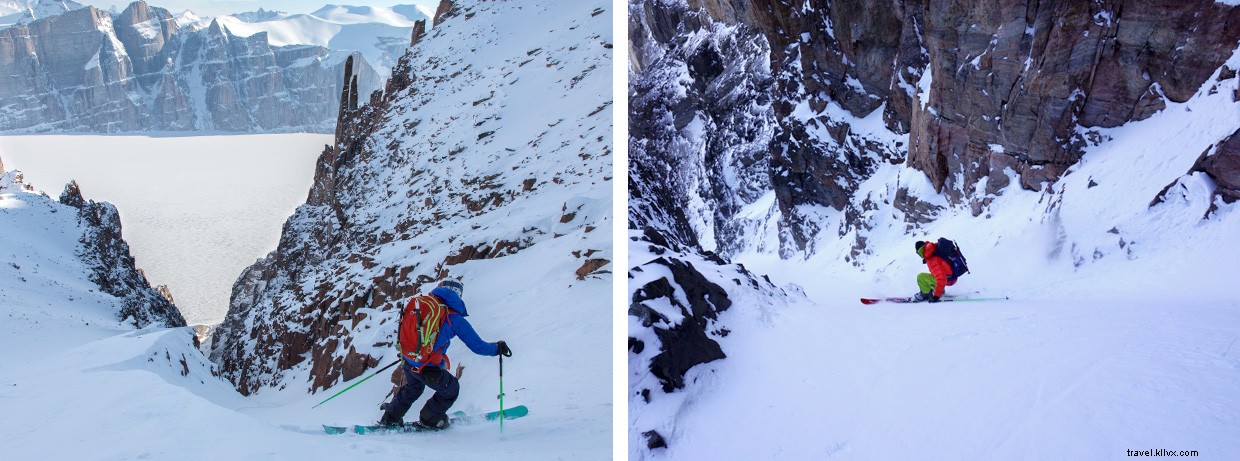
One day, still in Gibbs Fiord, we decided to travel deeper into the fiord to explore more and look for lines to ski. With the cloud base at 600m we passed a buttress akin to a fairy tale fortress with some of the biggest rock walls we had ever seen. A particularly intriguing couloir looked like it hit a cul-de-sac at 600m. With fading light and tiredness setting in we concluded this short line was too beautiful not to explore and as it would not take us long would be a good end to the day. We climbed quickly, but after an hour of boot-packing up the line we were surprised to find the couloir curved to the right, where we had thought it stopped. We continued on with little doubt that the couloir would probably stop round the next corner, such was the scale of the walls soaring up around us. It was too exciting to not carry on a little more, but increasing tiredness began to sap our motivation. Part of me hoped we would find a cul-de-sac a bit further on, but if the line went to the summit it would be a once-in-a-lifetime opportunity to ski a line unlike anything else in the world. I slowed my pace so Michelle could catch and we continued upwards around yet another corner. As we continued upwards, the couloir started to narrow from 100m wide to less than 10m. We rounded the next twist in the spiralling hallway that then narrowed and darkened even further and I wondered if we were going to be imprisoned right before the summit as light struggled to reach us from above. As we made our way up further a light started to peak through the gap in the wall at the end of the tunnel and I knew – it went the distance. As we got nearer the summit and looked back down the amphitheater like corridor, the anticipation and excitement of what we were about to ski stole away our tiredness.
We finally topped out on the plateau out just before midnight, as the sun dipped below the horizon, and we quickly swapped climbing gear for skis. Initially the couloir required tight, precision turns, but sluffy powder had accumulated after the night’s snowfall providing incredible softness that felt like we were bouncing, child like, on a feather mattress all the way down. Even on the steeper rolls the skiing gave way to rare feelings of pure and utter freedom that no words can describe. Every turn defined our passion in its purest form and what we ultimately live for. At the bottom of the line we celebrated together, all knowing that was one of those precious experiences that may never be relived.
Sponsored and Supported by:
Berghaus, Black Crows Skis, Mountain Boot Company, High5, Gino Watkins Memorial Fund, Wilderness Award, Alpine Ski Club, PLUM, Goal Zero, Lyon Equipment, Concept Pro Shop Chamonix, Western Logistics, Craig Stenhouse
Watch the film from the expedition here.