Carrying On: Sir Ranulph Fiennes’ Polar Expedition and Legacy
Everyone has heard of Sir Ranulph Fiennes. He is, after all, the perfect epitome of an explorer and completely mad-capped Englishman. His name is as ubiquitously mentioned down the pub as it is seen on the bookcases of the adventure section in your local library. Leader of the only team ever to to fully circumnavigate the world on its polar axis and the first man to completely cross the Antarctic continent unsupported, Ran is also one of UK’s top celebrity fundraisers, with an expressed aim of raising £20m for charity before – as he put it – he ‘pops it.’
There were so many questions we at Sidetracked wished to pose to Sir Ranulph, but in the end we decided ask the ‘world’s greatest living explorer’ a little bit about about the technology of bygone polar days, the problems with contemporary record-breaking, where the new frontiers in exploration lie and exactly what happened to those frostbitten fingers after his impromptu tool-shed amputation.
Sir Ranulph, you’ve done a host of impressive expeditions over the course of your career – for example undertakings such as the Transglobe Expedition – which are all known about widely within the outdoor community. So to begin, I wondered if you could perhaps tell us a little bit about one expedition that enthusiastic readers may still not have heard of?
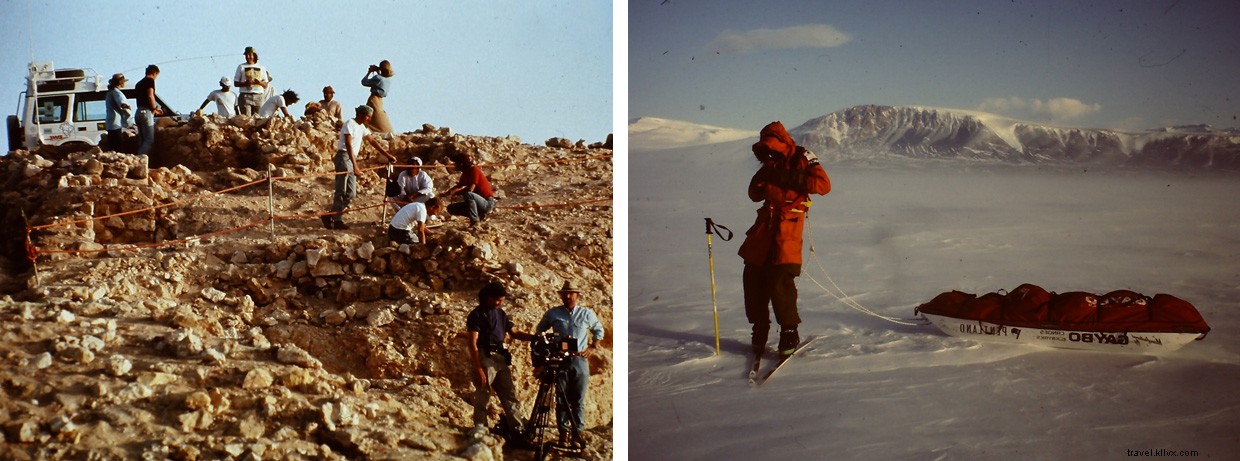
Well, we did seven expeditions in the Empty Quarter Desert. We were searching – and did not find until the last of the seven – the Lost City of Ubar, sometimes called the Atlantis of the Sands. In the Bible you have the city of Sodom. The people there were apparently naughty, God buried them and the city disappeared; that’s the myth. The Muslims have a similar version too, which is a place called Ubar, where the inhabitants behaved badly and the settlement disappeared. That’s what I started looking for in 1967 and eventually found in the early 1990s.
I didn’t do those expeditions with Charlie Burton or Mike Stroud or any of the other figures from my polar trips, I did them with my wife Ginny, who spoke Arabic and was a very good radio operator. Obviously communications were as important in the desert as they are in the snow. We kept not finding the city and each time we went to try, we had to solicit new sponsors. Land Rover were very good; they always sponsored us. But we had to keep approaching different companies with every attempt, like BP for all the fuel and local Omani supermarkets for the food. We also had to take on local Bedouin with their knowledge. It wasn’t an expedition which was widely known about, or rather the seven attempts to find it weren’t known. We eventually found Ubar in the early 1990s and it’s now the largest active excavation works in Arabia.
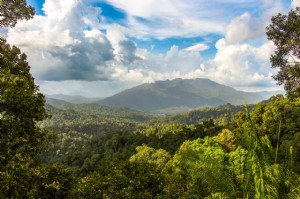
Your first polar-style expedition was to Greenland in the mid-1970s. Could you please tell us a bit about what the equipment and logistics were like back then, and how they might possibly compare to the kit on expeditions today?
Yes, well the communications equipment back then was all High Frequency (HF) and about two thirds of the time on an expedition you could only make contact through CW communication (morse-code). It didn’t really matter, as everybody involved got pretty quick at CW, but still one third of the time you could actually speak to people directly, which was pretty nice. The base commander and radio operator for the expeditions in those days was Ginny. She got all the gear together, trained other people and serviced and repaired the equipment. Her frequency prediction ability was brilliant. In Antarctica I can remember on one occasion, she was making voice communications with Cove Radio Station at Farnborough, whereas the British Antarctic Survey Bases were unable to contact Cambridge, which is their headquarters.
Then there’d be the person out in the field, who used HF man-packs to communicate back to the base commander. So you’d arrive at your camp at the end of the day; the person who first goes into the tent sorts it out, gets the coffee on the boil and would immediately put the radio battery up in the roof of the shelter for two hours to start warming it up. The other person – who would probably be the communicator and navigator – would be outside the tent getting slowly colder and colder, because he’d be working out what direction to set the radio equipment facing (and remember, there was no GPS until the early 1990s, because there were no satellites going over the Poles at that time). He would be using two skis sticks, definitely not metal ones, putting them in the snow about twenty yards away from each other, before stringing up antenna wire between the two sticks. The aim was for the wire to be horizontally facing the direction of where he thought Ginny was, several thousand miles away. If you’d done that correctly, then it would be the Number One important thing for establishing communications.
After that, you’d look in Ginny’s Ionospheric Prediction Book to get the best frequency by which to bounce the message off the ionosphere to the base-commander. Returning to the equipment, from the middle of the antenna wire you’d have a coaxial line coming out from it in a T-junction back through the tent door, into the tent and that would go into the radio set once you’d fixed it up. The set would then be warmed and switched on. Somebody would have a device round their knee that you whirred round and round and round and that acted as a battery charger, because in those days there were no suitable solar chargers. That would be the basic situation. You’d then hope that the HF frequency you’d chosen was correct for the behaviour of the ionosphere in the air above you. If not, you’d look on the piece of paper Ginny had given you months before, head out of the tent to change the frequency and try again. That’s a rough description, and it could take a long, long time.
In one sentence I can tell you what you now do instead of the ski stick method: you go into the tent, you take your sat phone out of your pocket, you drink your cup of tea, ring a number and tell them exactly what you want to say. Likewise with navigation, you do not spend an hour trying with a sextant tool to find the altitude of the sun or a star and then a further half an hour with sight reduction papers and a nautical almanac attempting to mathematically work out your position. You have another cup of tea, press another button on your GPS, and it tells you precisely where you’re standing. So in terms of the difference between then and now, it is simply huge.