Tyger! Tyger!: Spot Wild Tigers on Epic Safaris in Madhya Pradesh, India
MADHYA PRADESH, India – When we think of safaris, we think of Africa: lions, gazelles, the Serengeti, even Botswana. But if you want to see tigers, you're on the wrong continent.
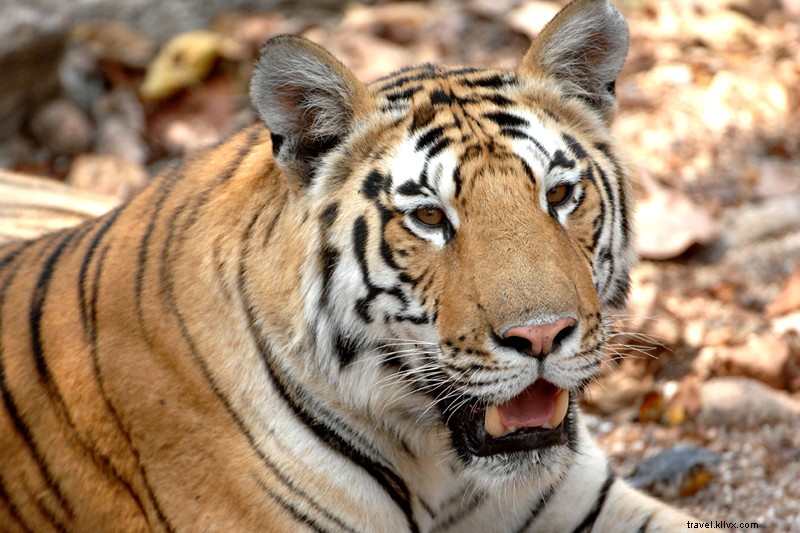
Native to Southeast Asia (where they can weigh 500-plus pounds of muscle, fur, claws, and snarl), half of the world's wild population lives in India. The solitary hunters may now number just 1,400 — less than half of what they were a decade before — but that's the allure of traveling so long and far into the dense green belly of India: for the chance to see something so startling, spellbinding, and rare. Wax as much as you like about the black and orange stripes, but until you've spotted their soft white kittenish loins rolling in a dry riverbed, you haven't really seen a tiger. Even if you've gaped at their claw marks on trees.
Jungle is a Hindi word. Where Africa has savannas and bush, India is thick with tropical groves and towering bamboo, sal, and teak, with strangler vines rising 50 feet and creeping from tree to tree. But there are also open grasslands and flowering valleys buzzing with dragonflies that arrive from Africa with the monsoons. So whether your guide drives past bounding langurs or grazing herds of wild boar or spotted deer, there'll be plenty of time to wonder if it's your karma to come back as one. If not as a 700-pound sambar, the tigers' favorite prey. Enjoy! Your next life could be over quick!
The greatest concentration of safari parks in India is in its central state, Madhya Pradesh, where India's Taj Hotels and South Africa's &Beyond have collaborated on four swank wildlife lodges. Baghvan's twelve bungalows hug the edge of 187,000-acre Pench National Park, an 80-minute flight from Mumbai to Nagpur, followed by a two-hour drive. The park is where Rudyard Kipling set his Jungle Books, and each morning the elephant drivers, or mahouts, set out on their hulking steeds to track the elusive tigers, before inviting you to climb onto their rickety platforms up top. It's no good feeling too strapped-in with tigers stalking below, so you won't have to worry about that. But afterwards it only takes spotting a stag to get back your sense of masculinity. Or seeing a peacock strut to make you feel like flashing your tail.
Make no mistake, it's hard work being on safari. Rising before dawn for the day's first drive in an open 4x4, past barking macaques, slinking jackals, grunting nilgais, 2,600-pound gaurs (the largest bovines in the world; imagine the offspring of a Fernando Botero and a Toyota Corolla), and the sprawling webs of giant wood spiders that look almost certain to hold them. Returning to camp for a breakfast of spicy dosas and banana lassis. Lounging by the pool until it's time for a lunch of stuffed rotis and curries. Driving in the afternoon on a search for sloth bears, leopards, red jungle fowl (the ancestor of every chicken and every chicken tikka), not to mention packs of wild dogs (they eat their prey while it's still alive, cleaning it to the bones in a few hours). Then attending high tea, proper cocktails, and tandoori dinners under the stars. And somehow finding the energy for all this, plus time for a hot bath or a few outdoor showers, an Ayurvedic massage, and anything more than a skeptical glance at the yoga and exercise equipment in every room.
Of Taj's four lodges, Mahua Kothi in Bandhavgarh National Park may be your best choice for spotting tigers. The park has one of the highest densities in India, as well as a gargantuan 10th-century statue of Lord Vishnu stretched out on a seven-headed cobra. Banjaar Tola in Kanha National Park features African-style tented camps in its own tiger-rich jungles, plus porcupines and hyenas, while Pashan Garh in Panna National Park is just 19 miles from the Hindu temples of Khajuraho, famous for their erotic, explicit sculptures.
With all the langurs leaping from tree to tree on my visit, it was hard to ignore the Kama Sutra's own sage advice about how, when the powders of the kantaka, lanjalika, and milk hedge plants are mixed with the excrement of a monkey and thrown on a woman, she'll never love anybody else. I wasn't sure how my wife would feel about this. Everyone wants to be careful with their clothes when they travel, but I also knew she had some new pashminas to break in. Luckily, my time in the Indian jungle had sharpened my acuity, so I knew if there was any trouble, I'd be keenly aware of the alarm calls.
When you drive in the jungle, first there's the greenness. It's a mouthful, eyeful, and faceful of twitching life. Then come the sounds: the rustling of leaves, the gurgling of streams, the mating calls, the wind and breeze sweeping sound and scent, the squeals and honks and screeches, the squawks and chirps, and the beating of wings. Then finally your nose kicks in, because the forest smells sweet and sometimes like baked bread, drizzled with lantana and frankincense, and even with peas and lentils. Yes, the forest teems with animals that want to eat it. Sometimes, though, there's also the fetid, wonderful stink of a kill, and you'll reach for her hand when you see the remains of a ribcage in the brush, where a tiger will have devoured the rest. That's when you'll feel your heart beating, too.
FIND IT
Lodges are remote and internet access isn't the most reliable, so we're not listing addresses for every property. For info, visit andbeyondindia.com. Rates range from $428 to $714 per person, per night, depending on the season. For more information or to book a trip, contact usa@andbeyond.com or +1-888-882-3742.
FOR YOUR BEDSIDE TABLE
The Jungle Book, by Rudyard Kipling