Japanese Earthquake Activity: History and Impact
2018 Hokkaido Earthquake 2016 Kyushu Earthquake 2011 Earthquake and Tsunami
The Japanese archipelago is located in an area where several continental and oceanic plates meet, causing frequent earthquakes and the presence of many volcanoes and hot springs across Japan. If earthquakes occur below or close to the ocean, they may trigger tsunami.
Historic earthquakes
Many parts of the country have experienced devastating earthquakes and tsunami in the past. The Great Kanto Earthquake, the worst in Japanese history, hit the Kanto plain around Tokyo in 1923 and resulted in the deaths of over 100,000 people.
In January 1995, a strong earthquake hit the city of Kobe and surroundings. Known as the Southern Hyogo Earthquake or Great Hanshin Earthquake, it killed 6,000 and injured 415,000 people. 100,000 homes were completely destroyed and 185,000 were severely damaged.
On March 11, 2011, the strongest ever recorded earthquake in Japan triggered a massive tsunami along the Pacific Coast of northeastern Japan. Known as the Great East Japan Earthquake, the earthquake and particularly the ensuing tsunami killed nearly 20,000 people and caused a nuclear accident at a power plant in Fukushima Prefecture.
Earthquake measurement
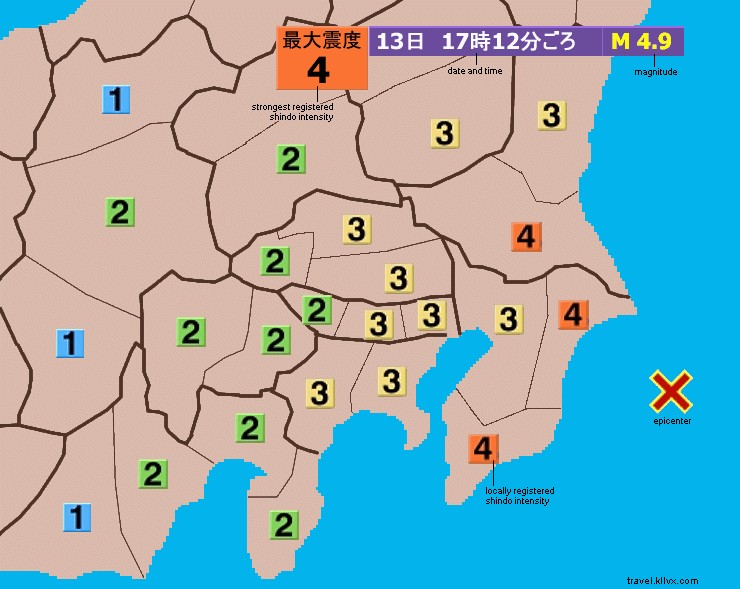
The Japanese shindo scale is most commonly used in Japan to describe earthquakes. Shindo refers to the intensity of an earthquake at a given location, i.e. what people actually feel at a given location, while the Richter scale measures the magnitude of an earthquake, i.e. the energy an earthquake releases at the epicenter.
The shindo scale ranges from shindo one, a slight earthquake felt only by people who are not moving, to shindo seven, a severe earthquake. Shindo two to four are still minor earthquakes that do not cause damage, while objects start to fall at shindo five, and heavier damage occurs at shindo six and seven.
| Shindo Scale | |
| 7 | It is impossible to remain standing. The quake is likely resulting in major damage and some deaths. Occurs only a few times per decade in Japan. |
| 6+ | It is impossible to remain standing. The quake is likely causing considerable damage and possibly some deaths. Occurs about once per year. |
| 6- | It is difficult to remain standing. Damage and injuries occur, but rarely fatal. Occurs about once or twice per year. |
| 5+ | Large furniture may topple and cause injuries, but no major damage to buildings. Occurs about 2-5 times per year. |
| 5- | Things fall off the shelves. Does not usually cause damage or injuries. Occurs about 4-12 times per year. |
| 4 | Hanging ceiling lights swing strongly, and unstable objects may topple. Occurs about twice per month somewhere in Japan. |
| 3 | Felt by most people. Usually occurs every few days somewhere in Japan. |
| 2 | Felt by many people. Usually occurs at least once per day somewhere in Japan. |
| 1 | Not felt by many people. Usually occurs several times per day somewhere in Japan. |
Preparedness
Every household should keep a survival kit with a flashlight, a radio, a first aid kit and enough food and water to last for a few days. Avoid placing heavy objects in places where they could easily fall during an earthquake and cause injury or block exits. Have a fire extinguisher. Familiarize yourself with the designated evacuation area in your neighborhood.
During and after an earthquake
Falling objects, toppling furniture and panic present the greatest dangers during an earthquake. Try to protect yourself under a table or doorway. Do not run outside, and try to remain as calm as possible. If you are in the streets, try to find protection from glass and other objects that may fall from surrounding buildings.
After a strong earthquake, turn off ovens, stoves and the main gas valve. Then listen to the radio or television for news. In coastal areas beware of possible tsunami while in mountainous areas beware of possible land slides.