Dawn Patrol: Protecting Nesting Sea Turtles on Sea Island
For most people, a 5:00 a.m. wake-up is daunting. But joining Sea Island’s experienced Naturalist, Raleigh Nyenhuis, on her daily sea turtle patrol makes it exhilarating. Now in her fourth season, Raleigh expertly monitors, researches, and safeguards the loggerhead sea turtles nesting on Sea Island’s pristine beaches.
 We met at the Beach Club and set off on a golf cart. With high tide at 6:30 a.m., we adjusted the route to start at Sea Island’s scenic north end, offering stunning views of secluded Little St. Simons Island across the water.
As dawn broke, we scanned the beach for signs of activity. Passing a nest marked earlier that week, our sharp eyes soon spotted fresh tracks—our first discovery of the morning.
These distinctive tracks mimic tire marks from a nesting mother turtle. First, Raleigh identified the species: loggerheads show alternating flipper patterns, unlike the parallel tracks of leatherbacks or greens. Loggerheads are the most common nesters in the Golden Isles. 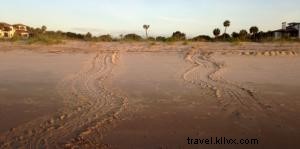
Next, we determined the direction: up-tracks (from ocean to dune) or down-tracks (return to sea). Nail marks form arrow shapes in the sand, pointing opposite the travel direction. Arrows toward the ocean confirmed up-tracks.
Then, we located the body pit—the excavation where eggs are laid and covered. No pit or eggs indicates a false crawl, when a turtle abandons nesting due to unsuitable conditions or threats. She’ll return within 48 hours to try again. Loggerheads nest 1–5 times per season.
Finding the eggs is delicate work. One egg per nest aids DNA research to identify the mother. Probing carefully, Raleigh located the air pocket, gently excavating to reveal the soft, ping-pong-sized eggs (no hard shells like chickens). Nests hold 100–125 eggs, hatching in about 60 days.
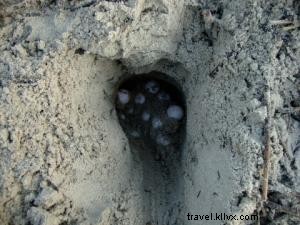 Nests may need relocation within 10 hours if below high tide or in high-traffic areas—after that, embryos attach, risking viability.
We marked the nest—Sea Island’s third of the season—for protection and monitoring. Raleigh checks daily for threats like weather or predators (raccoons, armadillos). Netting deters predators while allowing hatchlings to emerge. 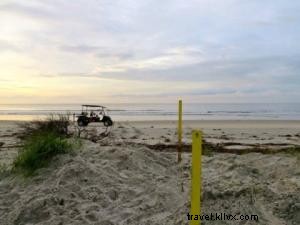
 The patrol yielded one false crawl and two more nests, ending just before offshore storms. A double rainbow capped the adventure!
At posting time, Sea Island had 42 nests, Jekyll 82, Little St. Simons 41, and St. Simons its first at Massengale Beach. Last year’s 300+ nests set a high bar—this season shows promise.
Experience Sea Turtles in the Golden Isles
Beloved icons, sea turtles peak during May–August+ nesting. The Georgia Sea Turtle Center on Jekyll Island (open since 2007) offers rehab, research, and education: view patients, observe procedures, and explore exhibits. 
Watch rehab releases via their Festivals & Events Calendar or Facebook. Join Turtle Walks (night, sightings possible) or Nest Walks (hatch inspections).
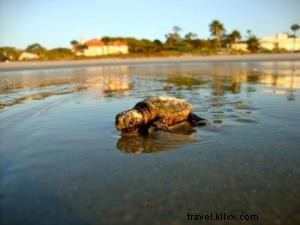 Cloister and Lodge at Sea Island guests enjoy Dawn Patrols or Night Walks. Inn at Sea Island (St. Simons) Resort Access Rate includes amenities. Little St. Simons offers patrols, inventories, night walks, and excavations.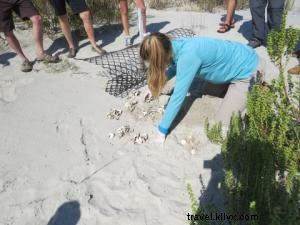
Protect Sea Turtles: Your Role
Loggerheads are U.S. threatened since 1978. Of 100+ eggs per nest, only 1 in 1,000 survives to adulthood—needing ~10 nests per recruit.
- Use turtle-safe flashlights at night.
- Fill beach holes before leaving.
- Avoid litter—plastic mimics jellyfish.
- Fishing hook? Net turtle, call GA DNR (912-264-7218); don’t cut line.
- Observe from afar—interaction is illegal and harmful.
- Watch roads for nesting terrapins; obey speeds.
Photos by licensed naturalists Kelly Patton, Raleigh Nyenhuis, and Elise Diehl. Never disturb turtles or nests.