Wright Brothers National Memorial Debuts CASSI: America's First Self-Driving Shuttle in a National Park
Outer Banks Visitors: Experience the First Self-Driving Shuttle in a U.S. National Park—Available Only Until July 16
The Wright Brothers National Memorial has launched CASSI, the first electric, autonomous transit shuttle in a U.S. national park—a fitting innovation at the birthplace of powered flight. This trial runs through July 16. We rode CASSI—standing for Connected Autonomous Shuttle Supporting Innovation—shortly after its debut. While fully autonomous, a safety operator is onboard to intervene if needed. The shuttle travels at 12 mph along a one-mile fixed route from the visitor center to the base of Kill Devil Hill, beneath the iconic 60-foot granite monument erected in 1932.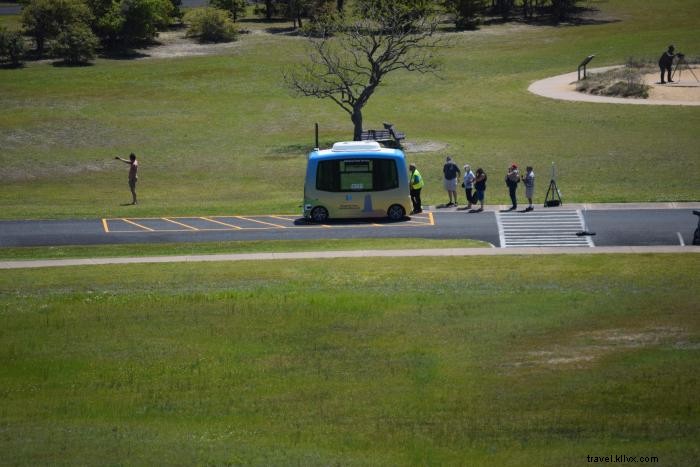 From this stop, visitors can access the 2003 centennial memorial sculpture—a full-scale bronze replica of the Wright Flyer and the seven witnesses to the historic December 17, 1903, first flight. Created by North Carolina sculptor Steven H. Smith, it recreates the exact moment captured in the famous photograph and was installed for the 100th anniversary, which attracted over 120,000 attendees.
Each 7-minute leg offers just six seats, so popular days may involve short waits for this National Park Service (NPS) milestone. The nearly three-month pilot assesses safety, public feedback, and collects valuable data.
Built by EasyMile in Toulouse, France—a leader in autonomous shuttles for passengers and goods—CASSI's $50,000 monthly operations are funded by a partnership between the NPS and the North Carolina Department of Transportation.
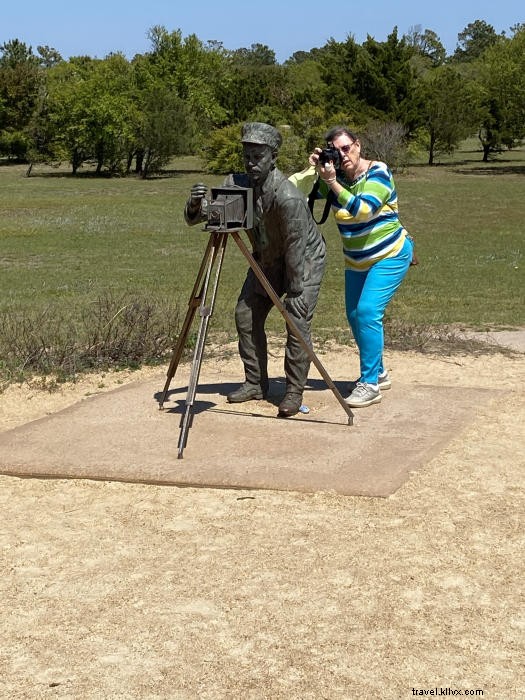
From this stop, visitors can access the 2003 centennial memorial sculpture—a full-scale bronze replica of the Wright Flyer and the seven witnesses to the historic December 17, 1903, first flight. Created by North Carolina sculptor Steven H. Smith, it recreates the exact moment captured in the famous photograph and was installed for the 100th anniversary, which attracted over 120,000 attendees.
Each 7-minute leg offers just six seats, so popular days may involve short waits for this National Park Service (NPS) milestone. The nearly three-month pilot assesses safety, public feedback, and collects valuable data.
Built by EasyMile in Toulouse, France—a leader in autonomous shuttles for passengers and goods—CASSI's $50,000 monthly operations are funded by a partnership between the NPS and the North Carolina Department of Transportation.
 Our standby operator, with 40 years training bus and streetcar drivers from New Orleans, shared with a smile: "When I stepped into an autonomous vehicle, I thought, 'What happened to the bus?' I've loved every minute since."
CASSI uses two 48-volt lithium batteries for GPS and electronics, plus a 12-volt car battery. Its GPS-mapped route leverages data from over 20 satellites in real time. At its core is a LiDAR system providing 360-degree awareness: it emits thousands of laser pulses per second, detecting vehicles, pedestrians, even birds—ensuring safe navigation. Just as the Wright brothers revolutionized travel, CASSI advances the future of transportation.
Our standby operator, with 40 years training bus and streetcar drivers from New Orleans, shared with a smile: "When I stepped into an autonomous vehicle, I thought, 'What happened to the bus?' I've loved every minute since."
CASSI uses two 48-volt lithium batteries for GPS and electronics, plus a 12-volt car battery. Its GPS-mapped route leverages data from over 20 satellites in real time. At its core is a LiDAR system providing 360-degree awareness: it emits thousands of laser pulses per second, detecting vehicles, pedestrians, even birds—ensuring safe navigation. Just as the Wright brothers revolutionized travel, CASSI advances the future of transportation.
Traveling with Teens in the Outer Banks (OBX): A Mom's Expert Planning Guide
Climb the Historic Bodie Island Lighthouse: Your Ultimate Outer Banks Guide