
The Enduring Mystery of Roanoke: What Happened to England's Lost Colony?
The site of England’s first American colony is often eclipsed by the pristine beaches of North Carolina’s Outer Banks barrier islands.
This is apt, as the Roanoke Island colony—explored in 1584, first settled in 1585, and re-established in 1587—is famously known as the Lost Colony. Backed by Sir Walter Raleigh, who received a royal patent from Queen Elizabeth I for “remote, heathen, and barbarous” Atlantic lands named Virginia (spanning modern North Carolina, Virginia, and beyond), the venture unfolded amid England’s rivalry with Spain.
Raleigh, alongside Sir Francis Drake and fellow explorers, juggled roles as courtiers, privateers, and adventurers. Today, the site is preserved by the National Park Service as Fort Raleigh National Historic Site, located about 20 minutes from Nags Head beaches and a short drive from charming Manteo—a coastal town named for the Native American who befriended early colonists and became the first baptized into the Church of England.
The initial 1585 settlers soon departed with Drake, who arrived after raiding Spanish ports in Santo Domingo (Dominican Republic), Cartagena (Colombia), and St. Augustine (Florida).
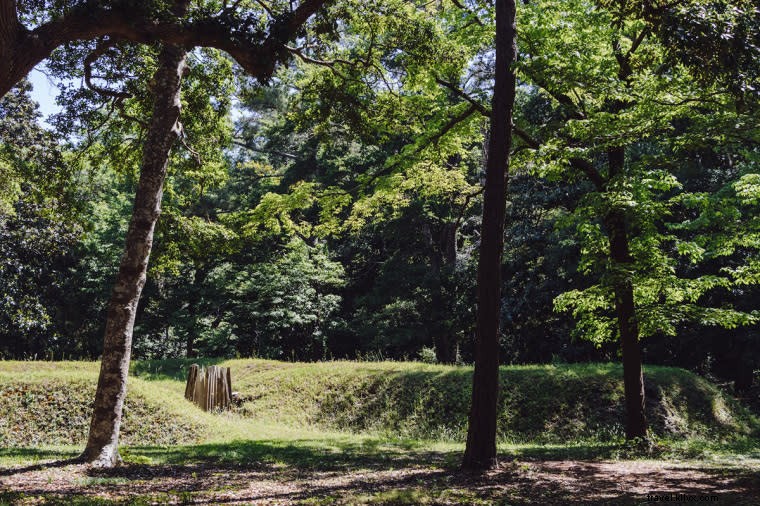
The reconstructed earthwork fort at Fort Raleigh National Historic Site, based on archaeological excavations. | Dennis Lennox
New arrivals under Governor John White in 1587 repurposed the abandoned site. White’s daughter gave birth to Virginia Dare, the first English child born in the New World, baptized using the Church of England’s 1559 Book of Common Prayer—a rite revived by Elizabeth I after her half-sister, Catholic Queen Mary.
Like the prior group, this settlement of over 100 men, women, and children—including White’s granddaughter—faced hardships. White sailed to England for supplies but was delayed by the 1588 Spanish Armada, aimed at conquering England and reversing the Reformation. Returning in 1590, he found the colony vanished, save for two clues: “CROATAN” carved in capitals and “CRO” abbreviated elsewhere. Later Jamestown searches yielded nothing.
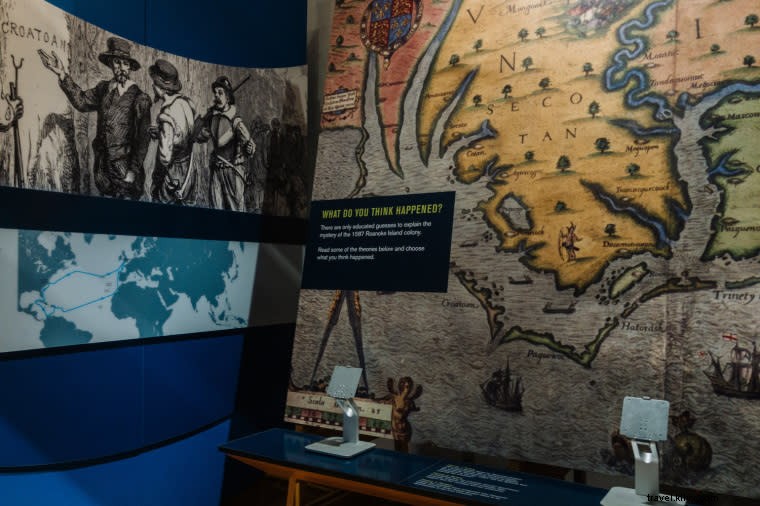
Inside the Adventure Museum at Roanoke Island Festival Park in Manteo, North Carolina. | Dennis Lennox
The fate of the colonists remains one of history’s greatest enigmas. During my Outer Banks visit, locals eagerly shared theories: many believe the English integrated with friendly Croatan (Manteo’s tribe) near modern Hatteras Island; others cite disease or intertribal violence.
Limited archaeology complicates matters—no bones indicate massacre or starvation. Beyond the 1950s-reconstructed earthwork fort, evidence is sparse. A National Park Service ranger explained that centuries of land use disturbed the site, while Daniel Hossack, manager of adjacent Elizabethan Gardens, noted erosion from hurricanes may have submerged original areas offshore.
Recent artifacts found 50 miles away offer fresh hope. The mystery fuels “The Lost Colony,” a Pulitzer-winning outdoor drama by Paul Green, performed since the 1930s at an amphitheater near the fort.
If You Go
I stayed at Holiday Inn Express Nags Head, boasting stunning beachfront views. History buffs may prefer The Roanoke Island Inn or The Tranquil House Inn in Manteo. Beyond Fort Raleigh, Roanoke Island Festival Park offers an engaging museum, the 69-foot Elizabeth II ship replica, and costumed interpreters. The 2021 “Lost Colony” production ran through August 21. This article originally appeared on ChristianPost.com.