Discovering the Enigmatic Landscape of the Faroe Islands
The grey flannel fog sat on its little cat feet and hid the tops of the hills from the sky and the rest of the island, isolating valleys from their neighbours. Even though it was cold and wet, drizzle hung in the air, suffocating us as it blew in from the tunnel and out again down the damp slopes, following the glistening road and twisting down to the few small houses in the village below. It was a time of quiet contemplation and waiting. I longed for lunch, for warmth, for coffee, and a breeze to blow the fog and drizzle away. Above all I longed for light – not brilliant light, more a burst from the clouds for a split second, rays and shafts, streaks piercing the clouds – anything but the hanging mist.
A trip to the Faroes can quite easily fall into a highlights reel, a ‘best of’ compilation. I was conscious of this, but I wanted Paul, who was on a mission for XPDTN3, and Fiola to help figure out where we visited, it was their first trip and my second the islands. A plan was half-formed about revisiting old postal routes inspired by a photo essay we’d seen on the BBC, but Heigli and Alfred, two local cyclists helping us with our logistics, thought this would be too technical for our gravel bikes. So we planned our trip using komoot to link up all the spots we wanted to see, together with advice from the locals, and left a route collection there for those who wanted to follow our tyre tracks.
Chasing waterfalls and hanging lakes
When we reach our lunch stop at Café Fjorooy in the secluded village of Gásadalur, we see old brown photographs of postmen and women adorning the walls. Long daily feats to connect villages by foot in the snow, gales, and rainstorms just to check if there was post to be collected – normal back then – would be mammoth undertakings today. We sit, soaked to the bone, in what has to be one of the world’s most-photographed villages, consisting of a collection of small houses balancing above the Múlafossur waterfall. This was the first highlight we’d pinpointed on komoot to visit, a spot I’d missed on my last visit, so I was keen to get the quintessential Faroese shot of the waterfall cascading unimpeded into the ocean.
Gásadalur wasn’t reachable by car until 2005, trapped on all sides by 600m-high mountains. Goods, post, and supplies had to be landed by boat or by helicopter or walked in over the mountains. Perched on a clifftop, it beggars belief that it was inhabited at all. Until British troops stationed there in 1940 built a stairway down to the water, the locals would walk the arduous 6km to sail their fishing boats out from Bøur, the nearest safe harbour. We drink hot coffee, eat cold open fish, egg and salad sandwiches, and swap wet socks for dry ones that stay dry for all of 30 seconds after we leave the café. We ponder the stories and pictures. It’s enough of a mission on bikes via a perfectly constructed road in the rain, yet these hardy characters did it daily, no matter the weather.
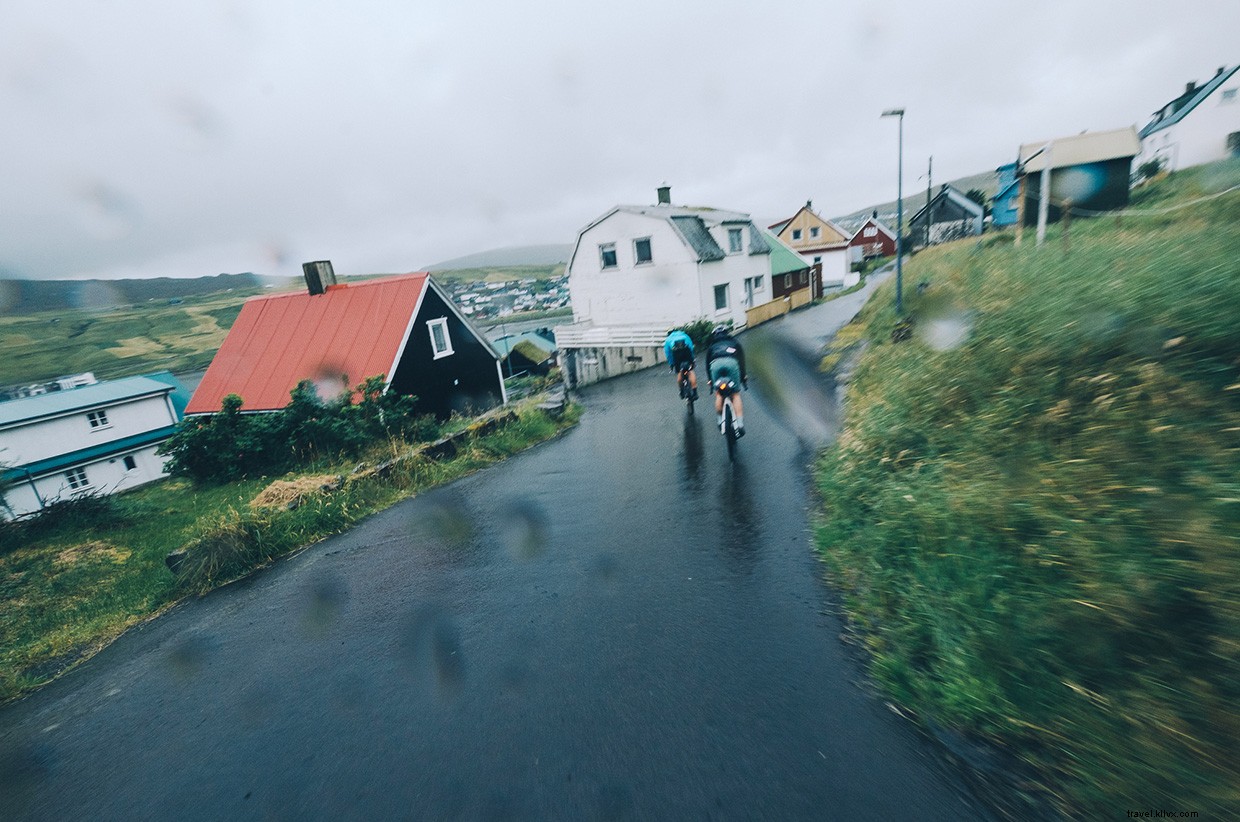
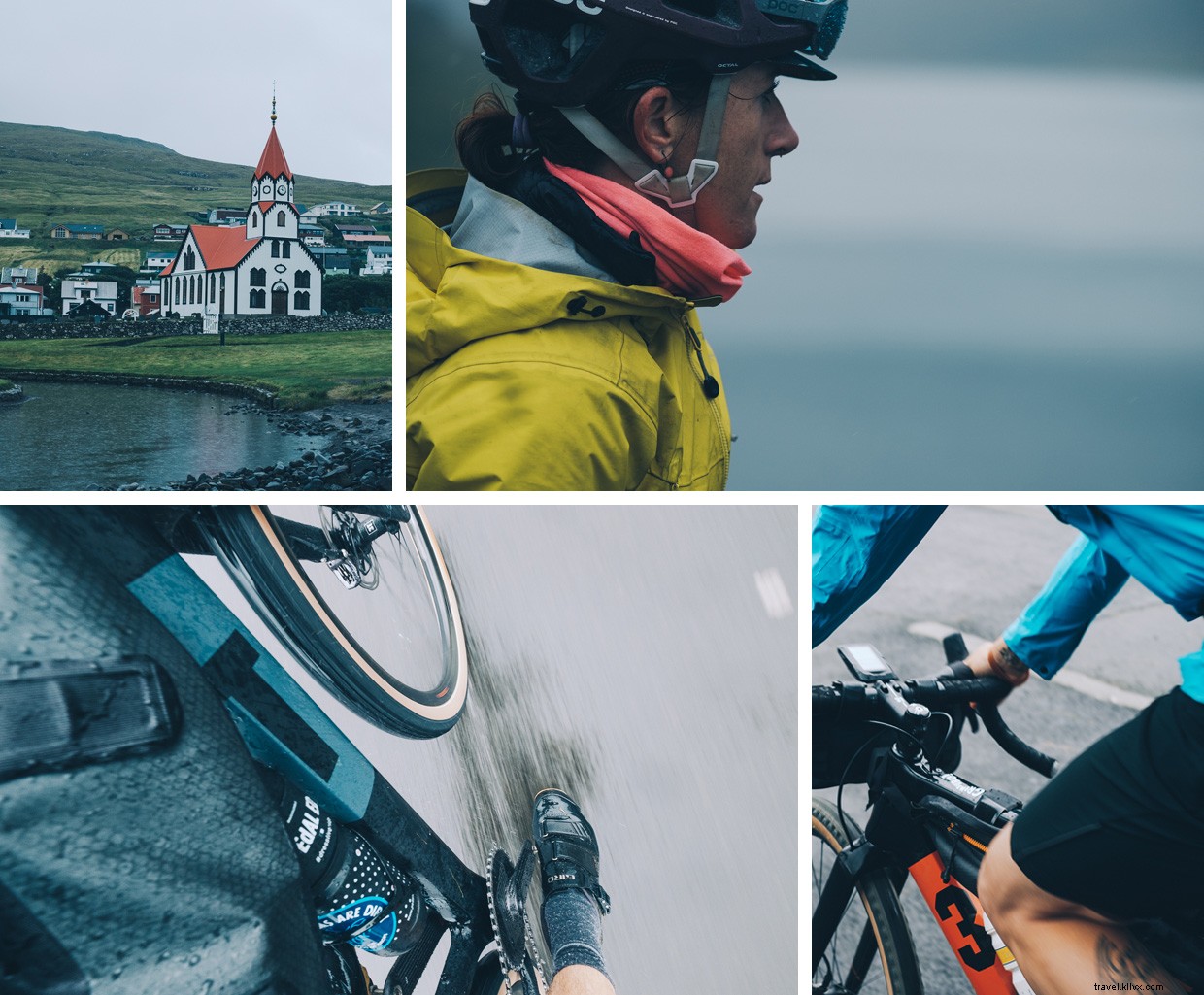
Slip slap slip slap slip slap go Paul’s tyres on the drenched tarmac. Slip slap slip, the rubber kicking up spray into my face – I daren’t drop back, don’t wanna get dropped or worse still hold everyone else up. Slap slip slap, I take it to the face. I’m getting rained on from above, in front and below as my own tyres fire water upwards, defying gravity. Slip slap slip, my mind wanders to a passage in Moby Dick where the narrator recalls spending time in a bed with Queequeg, a cannibal from the Southern Seas: ‘We felt very nice and snug, the more so since it was so chilly out of doors… because truly to enjoy bodily warmth, some small part of you must be cold.’ The warmth created forms a bond. I wish for that warmth, for a bed, for food, for dry clothes, and for my legs to stop spinning. But spin they do, for we have 30 bastard cold, wet and lumpy kilometres to go yet – slap slip slap.
I had last been on the island of Vagar four years ago when, coincidentally, the first murder in the Faroes in 25 years had taken place: a lovers’ tryst, a body never found but presumed dumped in a fjord, an international chase for the killer, and a quarter of a century of peace shattered. It also coincided with the Faroes tourist boom. We struggled to find a big enough car last time for five of us and surfboards, but times have changed – there are now more rental cars than local cars, the planes are bigger, and so is the terminal. Locals all have a stupid tourist story to tell. The car that fell in the ditch, the drone the farmer shot down… but the main gripe seems to be the lack of thought the government has put into infrastructure and education on how to deal with the influx.
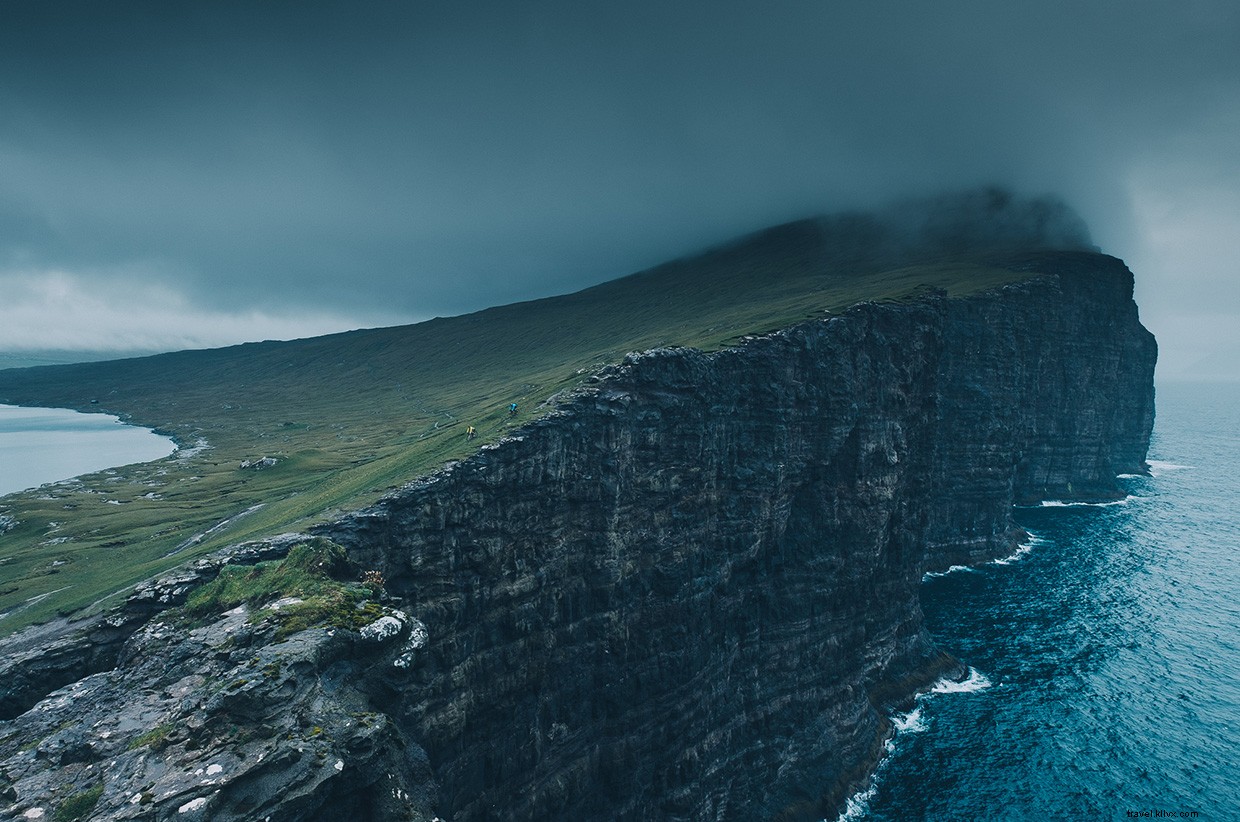
We hit a decent piece of muddy singletrack out to the lake Sørvágsvatn or Leitisvatn (the name changes depending whom you ask). It’s the largest lake in the Faroes and dubbed ‘the lake over the ocean’ or the ‘hanging lake’, as an optical illusion from a particular angle makes it seem as though the lake is hovering directly above the ocean. The impressive Bøsdalafossur waterfall empties into the sea at the end of the lake. It’s beautiful in the rain. We hit the increasingly muddy trail back to the road. Rain from our wheels, the passing trucks, cars and buses make it an uncomfortable but fast 30km of road – slap slip slap slip.
After showers, strawberries and cream, and coffee, all washed down with a Black Sheep beer, Alfred bundles our bikes into his trailer and takes us to a house in Elduvik where his mother cooks us dinner, fried fish, potatoes, carrot salad, and a sweet mustard sauce. To make us feel at home she has bought us a bottle of HP sauce. The islanders are often shy and reserved, resolutely stubborn, and don’t believe outsiders should tell them how to live their lives – but they’ll go out of their way to make you feel comfortable, and they are some of the warmest-hearted characters I’ve met. Alfred’s mother tells us about a deep-water canyon nearby the villagers use for swimming and I can only imagine how cold the water can get in the depths of winter. Dessert is a set rhubarb sauce with cream. Alfred tells us about how visiting football teams would be fed fish, potatoes, and rhubarb puddings before games so it ‘sat like a stone in their bellies’ – home advantage I guess.
I visit the canyon before dusk and the water is indeed freezing. It’s only then the rain stops and the clouds twist and twirl over the mountaintops creating the most beautiful reflections in the fjord below. I can still taste the grit and rain but all is forgiven as the road appears on the distant mountainside. We have to ride up it tomorrow. It winks at me, glistering in the newly found light, and I pray for the morning to bring half-decent weather.