Confronting the Depths of Fear: A Journey Through Tajikistan's Valleys
I awake with heavy eyes during the cool morning, my various aches and pains nudging me off the sleeping mat and out into the bright sunshine; onward again through the valleys of Tajikistan. Last night I stayed in a house with three women and numerous children approximately 300 kilometres from Dushanbe. I hadn’t slept well. The dogs barking throughout the night kept alerting me off my sleeping mat and – careful not to disturb one woman and her small child – over to the window to check on my bike Nellie Bly and the five bags attached to her sides and rear.
The previous morning I had separated from a Swiss cyclist who I had met in Bukhara and ridden with from Dushanbe. But after three days I knew it was time for me to go on alone, as my legs couldn’t keep up with his well-trained pace. I was holding him back, and I needed to stay behind for my photography anyhow as I think being solo always opens more opportunities. But it had been nice to have company for lunch and at camp for once, not to mention having a swimming partner before and after the midday naps.
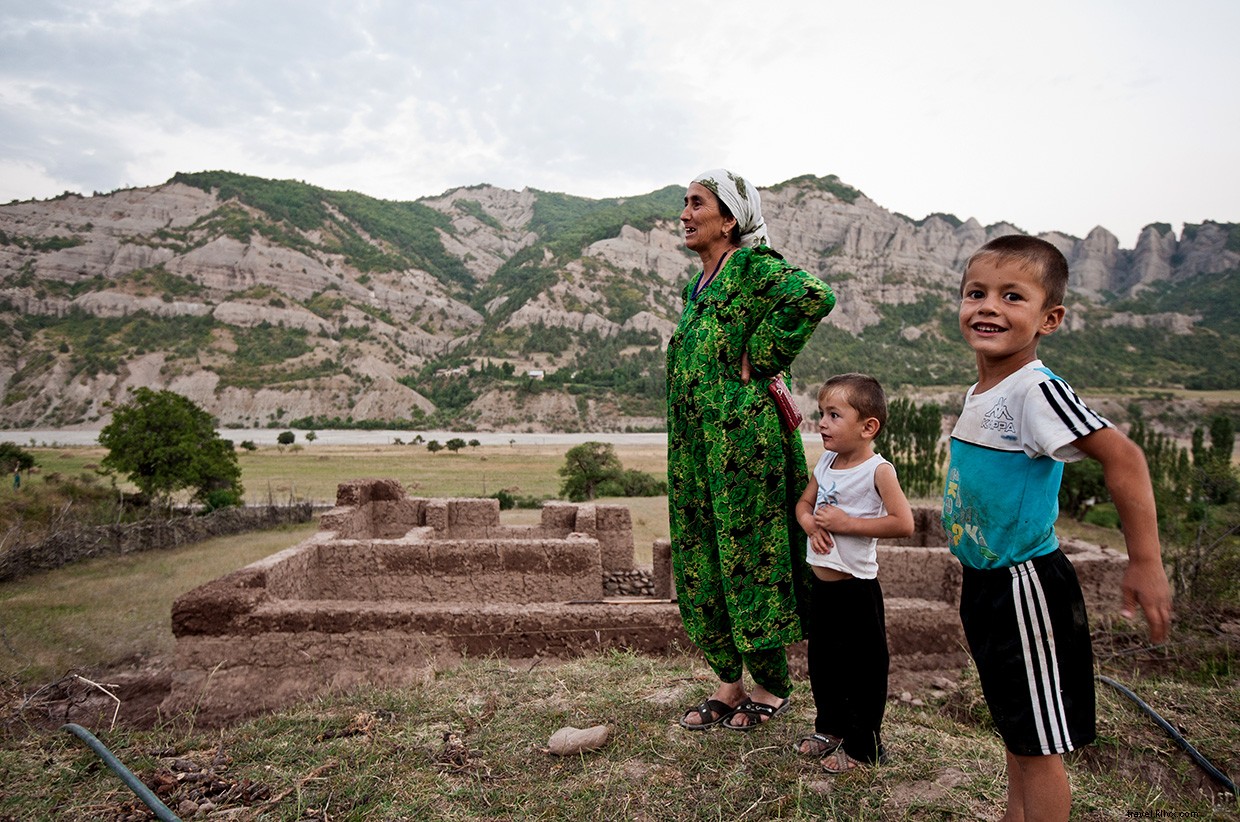
Yesterday, after separating, I was invited into a home by a few women, given a sponge bath by the eldest and then had a nap. This was followed later with dancing among the company of seven others. Two women there were married to one man, who was absent, and they used hand towels to explain the situation; pantomiming to me and inviting me to become the third wife, followed with laughter. I was taken through a tour of the gardens, visiting neighbours, and then going back home at sunset. I had gone to bed earlier than my hosts because it was Ramadan and they waited for night to fall through the valley on the outskirts of the Pamirs.
The sun hereabouts gets intense and the heat unbearable, sometimes reaching 48 degrees, so I need to make as much progress as quickly as possible. I had chosen to take a route that most people don’t ride; there was even a part on the map where there is a roadless gap. As usual, I was not quite sure what to expect but knew I wouldn’t be seeing dozens of cyclists on route. Sometimes there is a good reason why a particular road is not taken by the masses.
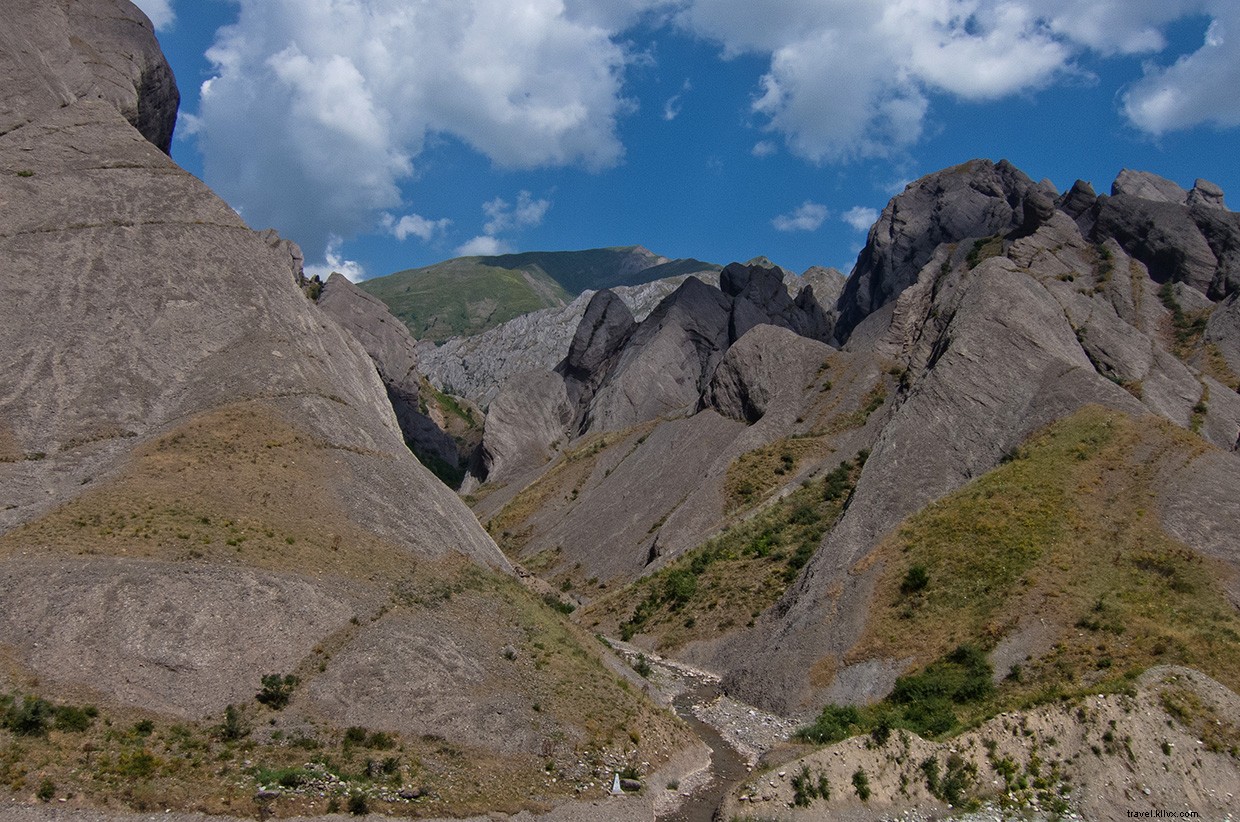
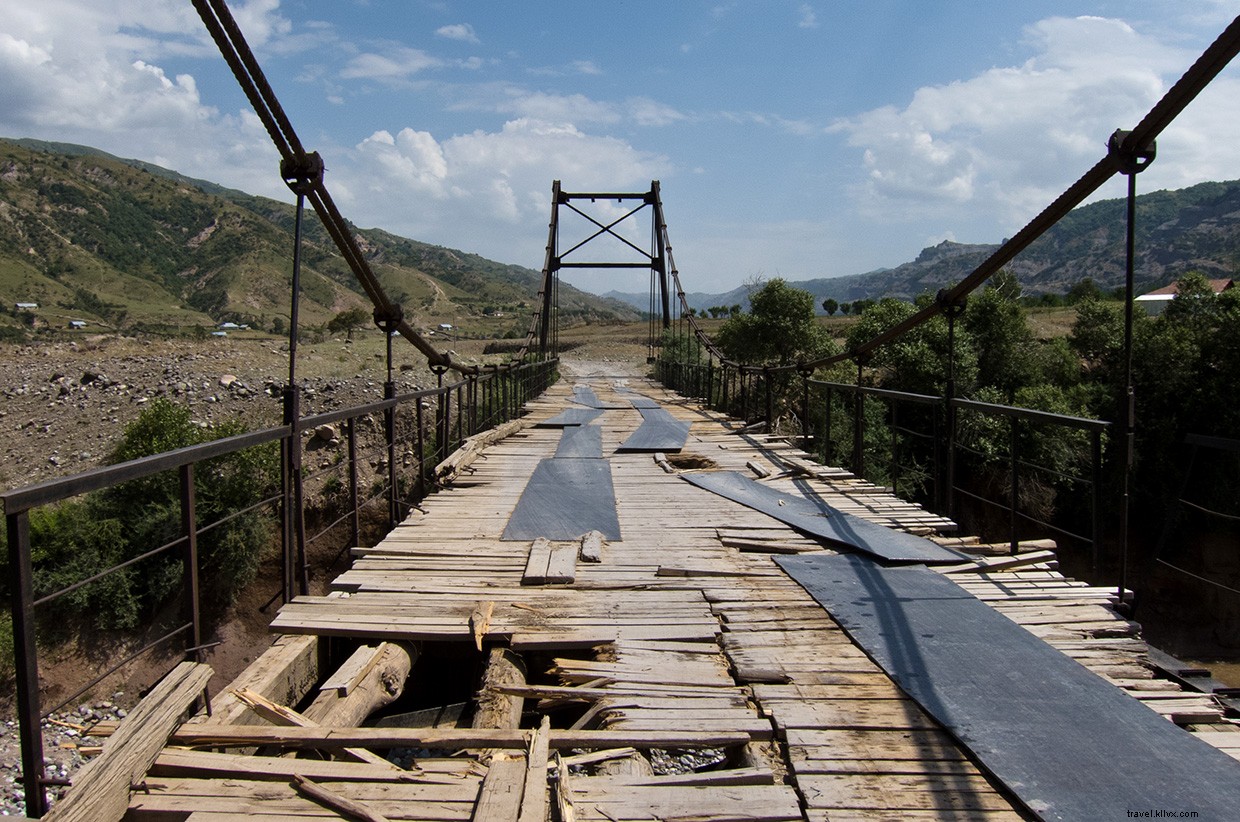
Thankfully there are dark storm clouds rolling in and there is a cool breeze on my skin; I know this will cut down immensely on the heat and I will be able to cycle through the early afternoon without a break. The trees are disappearing and it’s becoming a rocky and desolate post-mining landscape alongside a raging brown river. I had been warned of the rivers and glacier melts during the summers, later learning that the meltwater was much higher than average this summer. The water is angry and completely out of control. I can hear it beating against the stone banks and walls. There has only been one or two Land Rovers driving in the opposite direction since leaving the last town about four hours earlier. It’s becoming lifeless except for the massive rusted mining machines and mounds of grey stones.
Spotting a small pond where the water was flowing clear and shade was provided by some short trees, I decide to push over to watch the direction of the storm and to repair a snapped bolt on the front of the bike. There is no one around and I wash my clothes, feeling guilty of my freshly-cleaned body living in the filth and salted apparel. I put on some Atlas printed pants that were made in Dushanbe and hang my wet clothes up in the trees, needing to secure them as the storm is making its way closer. My hair tied and wrapped up on my head, I attempt to fix the snapped bolt. The best I can do is to use pliers to tighten the headless screw into the eyelet threads of the front fork. The world is completely grey, the damp clothes are getting a little rain, my hair is wet and I put on rain gear to cut down on my chills. Thinking it’s probably best to stay under this little bit of coverage, I begin to organize my panniers as I had dumped everything out digging for soaps and tools.
There is a sound in the bushes behind me, like the sound of something hard falling into dried grass. I stop, there is no one around. “What was that? Who is it?’ Another thumping sound, then another but then the object comes through the two metre high trees I’m standing under.
“Rocks!? Why in the hell are there rocks falling from the sky?” I walk out from under the trees and straighten up and look around. My left arm is hit with a piece of gravel then ‘crash!’ and another ‘crash!’, these are fist-sized stones if not bigger.
Across the gravel road and about 15 meters from me there is a cliff, approximately 50 meters high; up it I see a boy and his dog. The sky is dark and I can barely make him out has he begins to launch another rock, then another.
“Hey! You, I see you!” I shout in English. I had studied Russian for three weeks in Bishkek but when you begin to feel your blood boil it’s not so easy to squeeze out the translated words. He launches another and begins to pick up another rock. The rocks are getting bigger; the launches have less time between them. His aim is definitely improving too. I again repeat that I see him and he needs to stop, choosing a few choice four letter words that is understood throughout the world. The dog is barking and running back and forth along the edge of the cliff.
During my first few months of tour I learned my ‘War Cry’. The first time I used it I had no idea it even existed. It came to surface because it’s all I had to fight with. Since then it had gotten me out of a few situations, including dogs when I battle them for the leader of the pack. I knew it was time to let it out, as it takes some concentration and effort. Feelings, memories, frustrations are brought to the surface; I allow myself to feel vulnerable and scared. Opening my mouth to inhale has much air as my lungs can take the shrill call of death and fear exits my cracked and sunburned lips. I bend over at the waist to make sure it all exits. I let out another and another. Sometimes it almost feels difficult to stop. The boy and the dog have disappeared. I pack up my bike and know it’s time to get out of here as fast as possible. Slightly damp and clean clothes are put back on and my hair braided, assuming I would be leaving danger behind.
I had rested Nellie on her drive train side, so I could manage repairs. I’m a bit uncomfortable pulling her from the other side so she slips in the damp soil. The teeth from the triple crank puncture deeply in the front of my right ankle. The water nearby is turning bright red from the blood rushing from my body. There is nothing to do but try and remain calm. All I can question is, “Did I puncture something important? I hope this stops and I don’t bleed out here in the middle of nowhere Tajikistan.” I’m splashing water on it from the stream, which I know isn’t the best antiseptic to be cleaning an open wound with. It continues, and it’s not letting up.
A Tajik woman is now watching me from the cliff. Too many people are aware of me here now that I’ve let out the crazy woman ‘war cry’. The boy has also returned. I push the bike to the road keeping my eyes on my foot, watching the blood stream down the top. It’s going to be another battle scar. Deciding to walk the bike after the injury, the rocks, the scream, and the storm – just get the hell out of here. Experience was telling me I was finding myself way off the beaten path.
During the next two hours I would alternate between riding and pushing on foot through loose gravel, slowly going up some rocky and steep descents. Continuing upstream, I pass a man lounging atop a mound of stones nearly five meters high and he lazily assures me I’m headed in the correct direction. There are roads always branching off this mining road. Traversing through mounds of stones, old rusted mining machines and equipment, the road going up and down and crossing paths with a few massive trucks, assuming if I were going in the wrong direction they would alert me to the fact. Around three o’clock I come to stream. “Okay, well, it’s a bit wider and rougher and muddier than a stream,” I concede to myself. The raging brown water is coming down from the mountains on my right side and snaking to my left and continuing down through the villages I travelled through earlier.
Standing on the bank of massive stones and gravel, my thoughts and apprehension is drowned out by the water beating against the stones and cliffs. The opposite side of the bank is about 30 metres across and turns into a field of gravel and stones. No sight of a road or tracks either. The miners told me this was it, I can’t doubt the directions of locals. I set the bike on her side, briefly examining the dried blood all over my ankle and foot and noticing the flies enjoy taking a brief rest on the wounds. The water is rough, muddy. It’s bad, like nothing I’ve encountered before and I look up into the mountains cursing the summer glacier melt.
My previous day’s partner, Chris-Alex, is about 30 centimetres shorter than me. “If he can do it, I can do it too,” I tell myself, “Heck, and I’ve been on the road longer and am a seasoned veteran. This isn’t a big deal. Moseman, you can do this. You’ve been through hell and back. This isn’t anything.”
Taking a deep breath, holding the handlebars tightly from the left side, I give a good push into the water and the front wheel rolls forward and then drops so far down that the water is nearly rushing over my front panniers. The drop causes me to be pulled further into the water than anticipated. My heart skips when I realize that the wheel is not even touching the ground. Water is up to the bottom of the rear panniers and up to my knees. I can feel the front of the bike wanting to be whipped down the river. Nellie behaves like a buoy and I think if I can press the front down, it will help stabilize it.But this doesn’t work and the further the front goes down, the greater pressure I feel from the river pressing my bike against me.
Helicopters are above me. I had noticed them circling the area all day; I thought maybe they were surveying the high waters. I was later to learn that t that the reason for the helicopters was because a Civil War had erupted in the Pamirs that very morning. I look up, it’s hovering over me. “Do they see me? Are they worried for my safety?” The next few minutes would feel like hours.