Antarctica's Brighter Shades of Pale: Céline Cousteau's Epic Explorations
When your last name is Cousteau, life in a wetsuit seems like a given. And for Céline — granddaughter of legendary scuba explorer Jacques — preserving the Cousteau legacy means promoting the awesomeness of Earth. Through her work as a field producer, photographer, and documentarian, Céline travels to far-off places, monitors at-risk species, and protects the planet's natural resources. She sent in a postcard describing one of her explorations.
ANTARCTICA –Many people I know dream of journeying to the white continent, but it was never an ambition of mine. Then I shot a documentary there, and I fell under the spell of the magical land. Antarctica has the uncanny ability to enchant its visitors in a way no other place on this planet can.
It all began when I was asked to host a 12-part documentary series for Chilean television — I jumped on the occasion. Looking at the list of our destinations for filming, we would travel the entire coast of Chile, exploring areas above and below water, diving whenever we could, as far out as Antarctica. As much as I love new adventures in exotic lands, the idea of diving through icy waters brought bodily shivers. But as soon as I set foot on the terrain, I realized my reaction was only skin deep. What I felt, sensed, experienced, and remember were brilliant and intense reactions of falling in love with an incredible place.
We spent two days navigating the notorious Drake Passage, where we were blessed with unusually calm weather conditions. After that, our production team, anxious to film more than the creatures in the dining room, landed on the Antarctic peninsula.
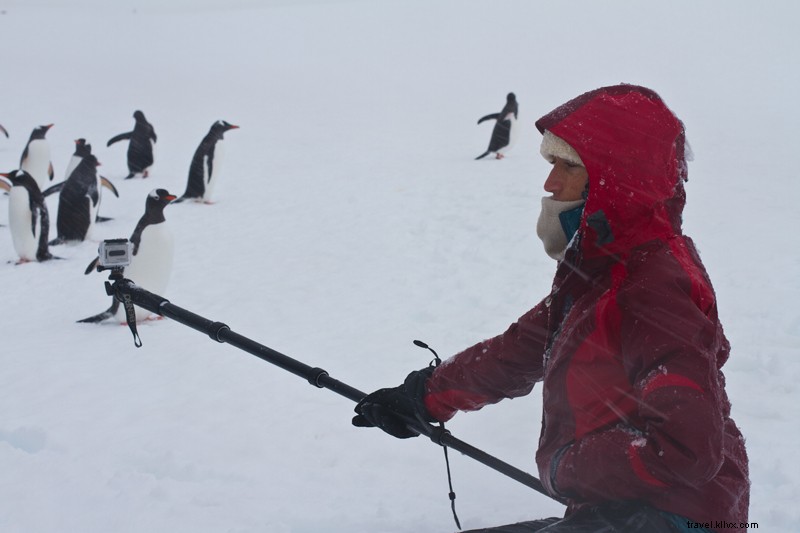
On our first stop, we tested our equipment. We divided into groups, one of which got into the water. I got dropped off on land with a videographer, in an area where Gentoo penguins were forming their colonies, getting ready for mating season. “We’ll be back soon to get you guys.” And they took off.
A somewhat gentle but determined snowstorm was already underway, creating an incredible landscape of beautiful white skies, white land, white flakes, and horizontal winds. Great to look at, tough to film in. We were there three hours! By the end, our gloves were soaked through, our bones were stiff, out clothes were sticking to our bodies, and a permanent smile spread across our faces.
We had stationed ourselves near the path of the migrating Gentoos, photographing and filming them as they waddled past us. Our various cameras, including a small one on a long monopod, allowed us to get really close without being too intrusive. We could not help but anthropomorphize the creatures and narrated some their looks as they tilted their heads and eyes, assessing us as they scooted past. Unbeknownst to them we had a few conversations going, too. We were witnesses to an incredible life-happening: that of simple survival.
Though our reason for being there was to film, this is a journey a few determined people can also make, since there are boats that take limited groups of visitors to the area. We had traveled down on such a boat, our production partially supported by the owners, and though we followed their path, we took off on our own to film. For those who aspire to see and experience this place, I suggest you do so — but please be mindful that this area is fragile, under great pressure from the global changes on our planet. It is important that we keep the numbers to a minimum so as to avoid creating any greater impact than humans already have. Most importantly, what is learned there should be taken home; the care and thoughtfulness with which we tread on the white continent should be applied to our own backyards.
FIND IT
Cousteau traveled on a ship called Antarctic Dream. It leaves from Ushuaia, Argentina.