TSA Airport Security: Snow Globes, Body Scanners, Health Risks, and Pat-Down Experiences
It's true: the TSA prohibits snow globes containing more than 3.4 ounces of liquid due to security concerns. Check the full list of prohibited items on the official TSA website before your next flight.
As many travelers know, the TSA has introduced advanced imaging technology (AIT) scanners—sometimes called “body scanners”—at select U.S. airports. These are not yet available everywhere. Visit the TSA website for a current list of equipped airports.
Not everyone is selected for the scanner; selection is random. Most passengers proceed through standard metal detectors.
Concerns about these scanners often focus on health risks and privacy. Here's a balanced look:
Health Risks: Arguments For and Against Body Scanners
Supporting Safety: The TSA states that each full-body scan emits less than 10 microREM of radiation—equivalent to about 2 minutes of exposure during a flight at cruising altitude (per TSA FAQ).
Potential Concerns: The ACLU has referenced expert opinions noting that while whole-body doses may be low, skin exposure could be higher since the X-rays target the skin surface. Many travelers opt for pat-downs to avoid any perceived risks.
Privacy is another key issue. The scanners produce generic body outlines, not detailed images. Here's an example of a scanner image: 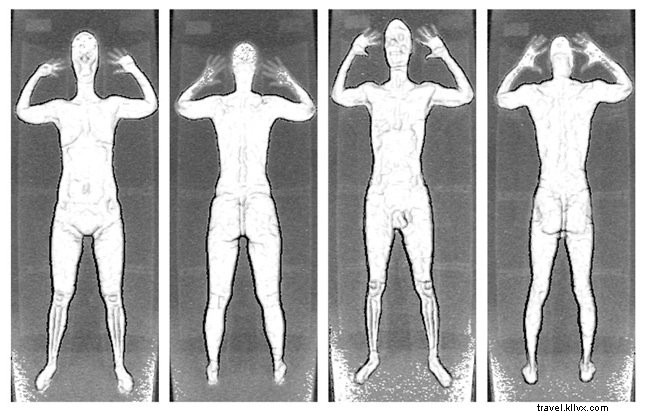
Regarding image storage: TSA machines are configured not to save images by default. However, a 2010 incident involved U.S. Marshals saving images from a similar scanner at a Florida courthouse, raising valid questions about policy enforcement.
A broader debate: Has the TSA stopped any terrorist plots? A CBS News report from 2012 indicated zero arrests of potential hijackers at checkpoints since inception. Airport security remains essential, though effectiveness is debated. (Note: TSA agents do enforce rules like the 3.4-ounce liquid limit effectively.)
Personal Experience: On a recent trip to the Dominican Republic, I opted out of the scanner at an equipped airport. The TSA officer was professional, explaining each step of the pat-down procedure. It involved no discomfort—just holding arms outstretched (not up, as I initially did!). This contrasted with sensationalized media reports.
What are your thoughts on TSA body scanners? Have you experienced one or a pat-down? Share below.
(Cover photo by Richard Boenigk)