
Captivating Maine Puffin Photographs That Inspire Hope for Wildlife
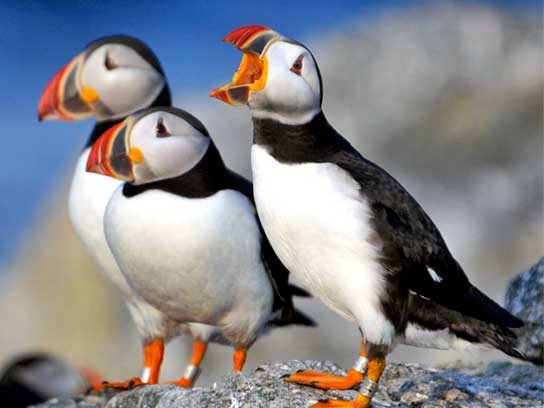
If puffins could talk, this is what they’d tell us.
They’d want to share the inspiring story of how one scientist—assisted by the efforts of many other people—followed his dream and helped restore this adorable aquatic bird to the islands of America’s northeasternmost state. (Btw, the sound of a puffin “talking” most closely resembles a chainsaw.)
Meet Stephen Kress, a man with a plan
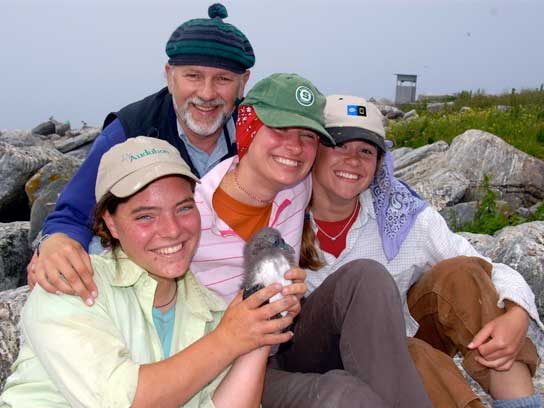
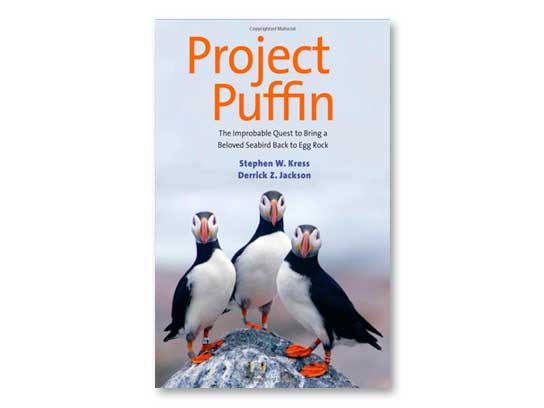
Here is a recent photo of Stephen W. Kress, PhD (in the green beanie) with researchers Juliet Lamb, Lauren Scopel, and Merra Howe. Kress is an eminent ornithologist—the National Audubon Society’s Vice President for Bird Conservation and a visiting fellow at the Cornell Lab of Ornithology. In the early 1970s, he was an ornithology instructor at Hog Island Audubon Camp in Maine. While he saw plentiful gulls and terns, he saw nary a puffin. After he read that puffins had been a common sight until the 1880s when they were decimated by hunters and people harvesting their eggs, he wondered if the birds could make a comeback. “Because humans caused the puffins to disappear, it was our obligation to bring them back,” he writes in his new book Project Puffin (co-written with Derrick Z. Jackson).
Picking the perfect place for puffins
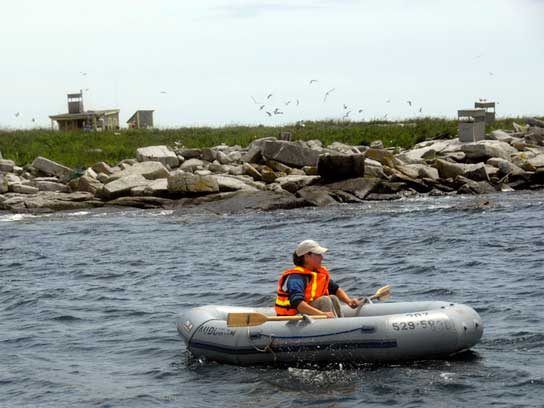
Kress based his audacious effort at Eastern Egg Rock, an uninhabited, seven-acre isle off Maine’s Pemaquid Point in Muscongous Bay. Because puffins tend to return to breed every year at the spot where they grew up, he decided that the best plan would be to construct burrows on Eastern Egg, bring in 13- to-18-day-old pufflings (the name for puffin chicks) from Canada, put them in the burrows, and feed them until they hit six weeks. That’s when they instinctively head to the ocean and live at sea for years. Kress expected the puffins to make their first foray back to Eastern Egg when they reached breeding age, or 5.
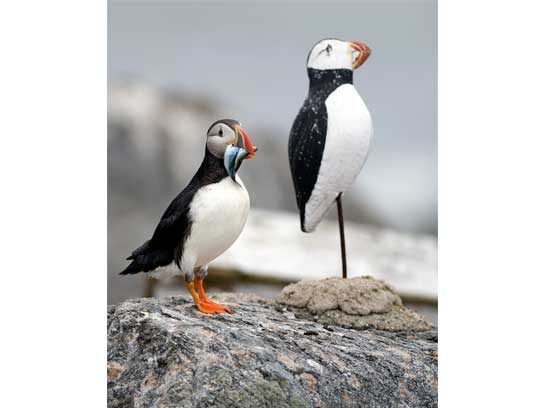
What do puffins need? Other puffins!
From the summer of 1973 through the summer of 1976, Kress and his colleagues fledged more than 240 pufflings at Eastern Egg Rock. After a few years, they realized that because puffins are very social, the birds would return only if they saw other members of their species there. So the researchers scattered wooden puffin decoys and in 1977, Kress enjoyed his first triumph when he saw that some of the project’s puffins—identified by their banded legs—were visiting the island where they were raised. Much to Kress’s frustration, the birds did not stay to breed.
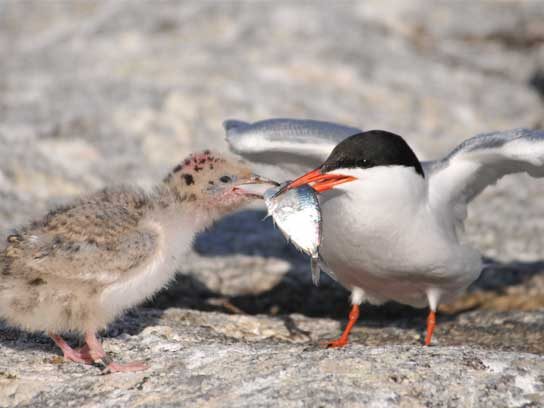
They flock to other feathered friends, too
Another obstacle: Puffins do not like living near gulls, which eat puffin eggs. The gull population at Eastern Egg was high. Not only did the researchers reduce the number of gulls, but they also encouraged the growth of terns, which drive off gulls and co-exist peacefully with puffins. Since the puffin decoys worked so well, the ornithologists installed tern decoys and also played recordings of tern courtship sounds. Success! Terns began nesting there. (Shown, a common tern feeding a chick.)
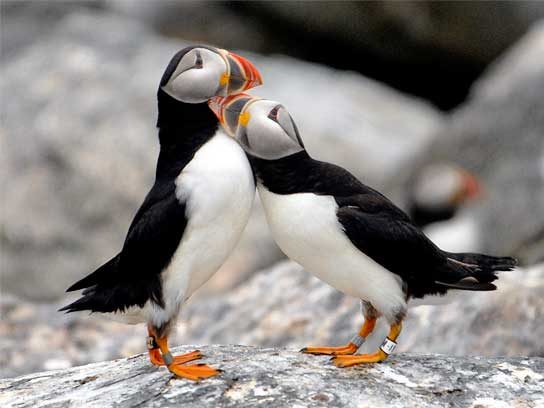
Finally, the sight the researchers were waiting for!
In 1981—eight long years after Kress and colleagues started their project—they spotted returning puffins on Eastern Egg Rock exhibiting courtship behavior (like nuzzling, shown), digging burrows, and breeding.

Puffins: pro fishermen
Puffins are experts at catching fish—and they particularly excel at holding several catches in their mouths at the same time. They use their tongue to secure the first fish against the roof of their mouth so they can open their beak and snare more. This puffin is most likely bringing back food for its puffling. Each female lays just one egg a year.
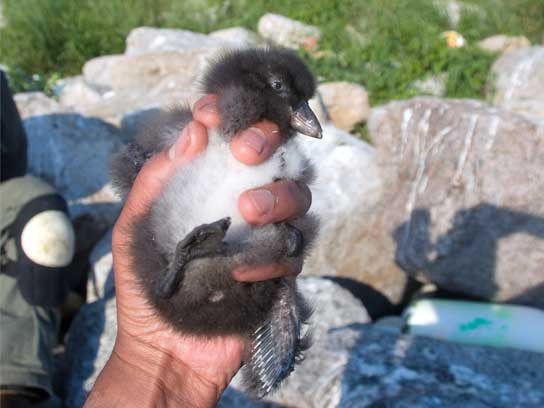
Too fuzzy for words
Puffins are covered with down when young but by the time they’re ready to leave their burrows at six weeks, they are fully feathered. Unlike six-week-old, say, humans, puffins at that age are highly self-sufficient. They go to the sea entirely on their own, and they learn to feed, migrate, and survive by themselves.
This is called “grubbing for pufflings”
Every summer, Kress’s researchers scour Eastern Egg Rock for burrows and reach way down into them—the burrows may be up to eight feet deep—to extract baby puffins and band them.

Take an up-close look
Puffins develop their rainbow-hued bill at age 2. The raised ridges on the orange part appear at 3 years or older. This bird was photographed during spring courtship season. The giveaway? That’s when their bill, eye, and rosette (the patch of skin near its beak) are brightly colored. While male and female puffins have the same coloring, size is the main differentiator: the male puffin is a bit larger.
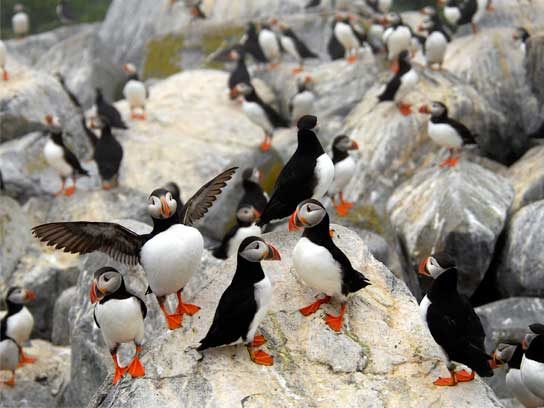
And now, a plethora of puffins!
Thanks to Kress and his team, there are more than 7,000 nesting seabirds at Eastern Egg Rock, including more than 100 pairs of puffins. Visitors to Maine can go on puffin-watching cruises and see the colorful sea parrots—as they once were called—back where they belong.
Read all about it
To learn more about this incredible initiative. which has helped influence other conservation efforts, check out the book Project Puffin: The Improbable Quest to Bring a Beloved Seabird Back to Egg Rock (Yale University Press), by Stephen W. Kress and Derrick Z. Jackson. And the next time you’re in Maine, stop by the Project Puffin Visitor Center in Rockland, or take a nature cruise—in the warm-weather months, boats depart from New Harbor and from Boothbay Harbor.