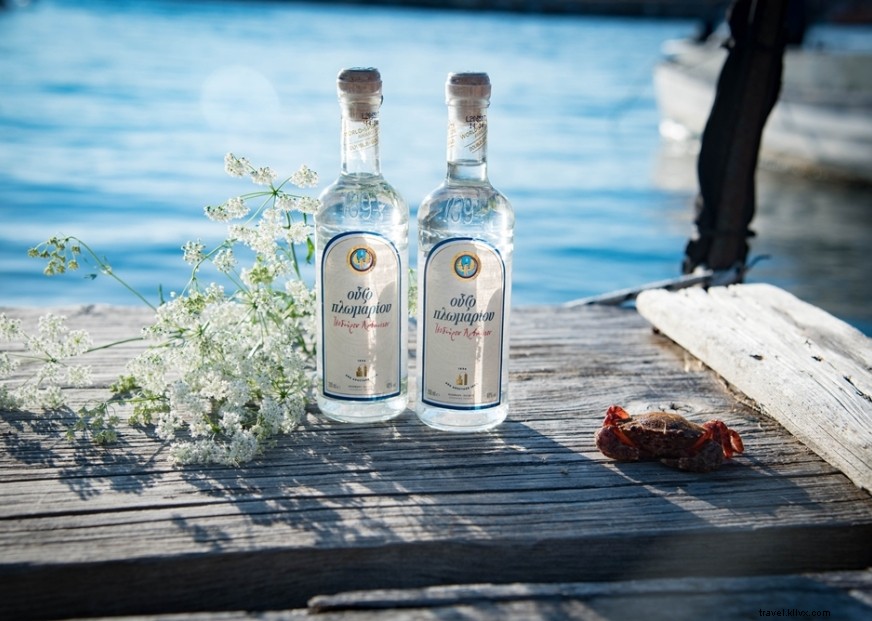
Lesvos has a long tradition in the ouzo production and the village of Plomari is considered to be the homeland of ouzo. Production started in the 19th century and continues until today. The island is endowed with fertile land and a big variety of plants and herbs. This, combined with the geographical position of Lesvos, at the crossroads of Europe and Asia, helped the local producers to produce and market ouzo of excellent quality. The population of Plomari, consisting of cosmopolitan seamen and traders, were a wealthy class who enjoyed the pleasures of life. The scented drink matched perfectly with their adventurous character and helped them travel with their minds to faraway places even when their ships were anchored. They were the ones who started the trade and exports of ouzo.
The Plomari Ouzo Distillery Isidoros Arvanitis
“THE WORLD OF OUZO”
The Plomari Ouzo Distillery Isidoros Arvanitis is located in a magnificent olive grove in the picturesque Plomari, the place where Ouzo of Plomari was first created by Isidoros Arvanitis in 1894 and where it has been produced for over 120 years. Recently, the distillery “opened” its doors for the first time to the public, inviting ouzo lovers to visit its premises and “live” a unique experience for all senses. Guests have the opportunity to see from up close the traditional production process, in 18 small copper stills, all handmade by the same family of coppersmiths. Visitors can enjoy a collection of museum artefacts which complements a unique experience of an unforgettable journey through time. This collection illustrates the evolution of ouzo production through centuries and includes items used during the distillation and bottling processes.
The Plomari Ouzo Distillery Isidoros Arvanitis is the most important investment in Lesvos, contributes to the island’s prosperity and supports the local community employing more than 50 people.
 THE RITUAL OF OUZO CONSUMPTION
In Greece, traditionally ouzo is consumed as an aperitif, but also with appetizers and seafood before and during the meal. In many export markets, it is consumed as a digestif or a shot, due to the digestive properties of its plants and herbs. (Advice: pour the ouzo first, then add water, and last the ice to enjoy the ouzo aromas to their fullest extent).
Isidoros Arvanitis
Ouzo Plomari
The World of Ouzo
Adolo
Facebook