Circumnavigating the World by Human Power: The 13-Year Journey of Steve Smith and Jason
Jason: It was a friend of mine from university, Steve Smith, and he had the idea. Parts of the journey had been done before; people had ridden bikes across continents, and a few people at this point – 1992 – had rowed across oceans. But no one had connected a continuous journey to circumnavigate the world by just using human power, no motors or sails. Neither of us were adventurers at the time; he was an environmental scientist and I actually had a window cleaning business in West London.
When Steve asked me to join, I was really struck by how beautifully simple the idea was. The means to do the expedition had been around for centuries, but no one had yet done it. It sounded like one of those amazing journeys, where you didn’t have to be an expert in mountaineering or polar travel; anyone theoretically could do this expedition and that’s what really appealed to me.
There was two years of planning and preparation. There was a year of boat building; we custom built the vessel that we travelled across the oceans in. It’s a pedal powered boat, 26-foot-long by 4.5-foot-wide, and we carried enough food and provisions for two people to survive up to 100-odd days at sea without resupply. Then there was trying – unsuccessfully – to get sponsorship. We managed to get some equipment donated, but nobody wanted to put any money behind it.
After two years, finally, we thought we’d borrow a bit of money and see how far we’d get. So in July 1994, we set off from Greenwich and we had just enough money to launch the boat on the Atlantic off the Portuguese coast, after biking down from France, Spain and Portugal. We had food donated from the British Army so we knew we could get to ourselves to Miami; after that we’d just have worry about how we would continue the thing from then on.
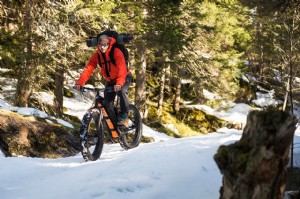
Overland it was biking, walking and rollerblading, between the islands – like in Indonesia for example – it was kayaking, swimming the rivers, using the specially-designed pedal-powered boat to cross the oceans, and then using a rowboat to cross some of the smaller water sections like the Bosphorus in Istanbul for example.
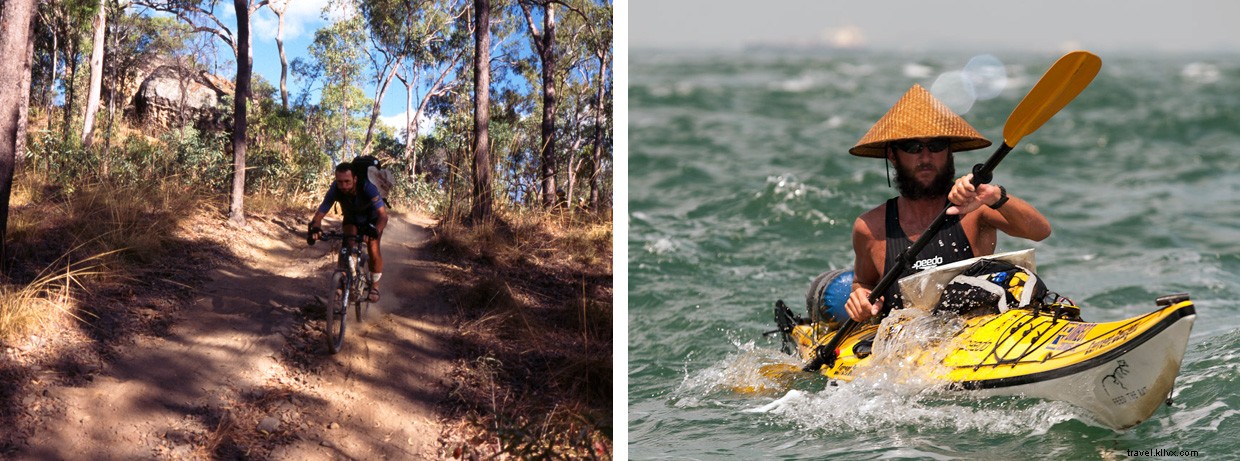
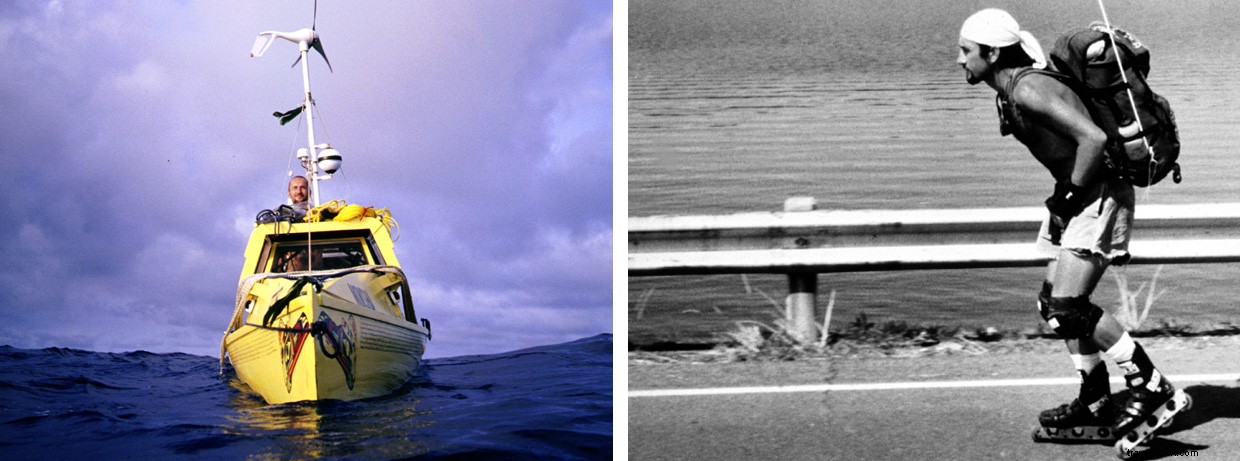
Well biking is the most efficient; you can bike 100 miles a day quite easily and given that it is human-powered, that’s a pretty efficient way of getting across continents. Rollerblading sounded like a great idea – no one had yet inline-skated across North America, so that appealed to me somewhat. But it was hard work; 50 miles on inline-skates was a really hard day, a really big day, especially if the road surface was bad.
I suppose kayaking was the most enjoyable method to travel over water by, but again it was very laborious, whereas in a pedal boat I could notch up more like 50 to 60 miles in a day. But the beauty of a kayak is that you’re much more connected with your environment and you have the immediacy of the water right there, so in a way it’s more enjoyable than being in a little survival-capsule out to sea, where nothing changes for days on end.
Well in order to fulfil the criteria for circumnavigation as set by Guinness World Records, and another adjudicating body, Explorersweb, I had to hit two points on the surface of the globe that were antipodal to each other, diametrically opposite one another. If you hit two of these points you automatically travel all lines of longitude, you travel the minimum circumference of the equator, and you have to cross the equator at least twice.
This really stops people from just travelling in one hemisphere and claiming a circumnavigation, because that’s half the distance, and you’re also going with the prevailing wind and current all the time.
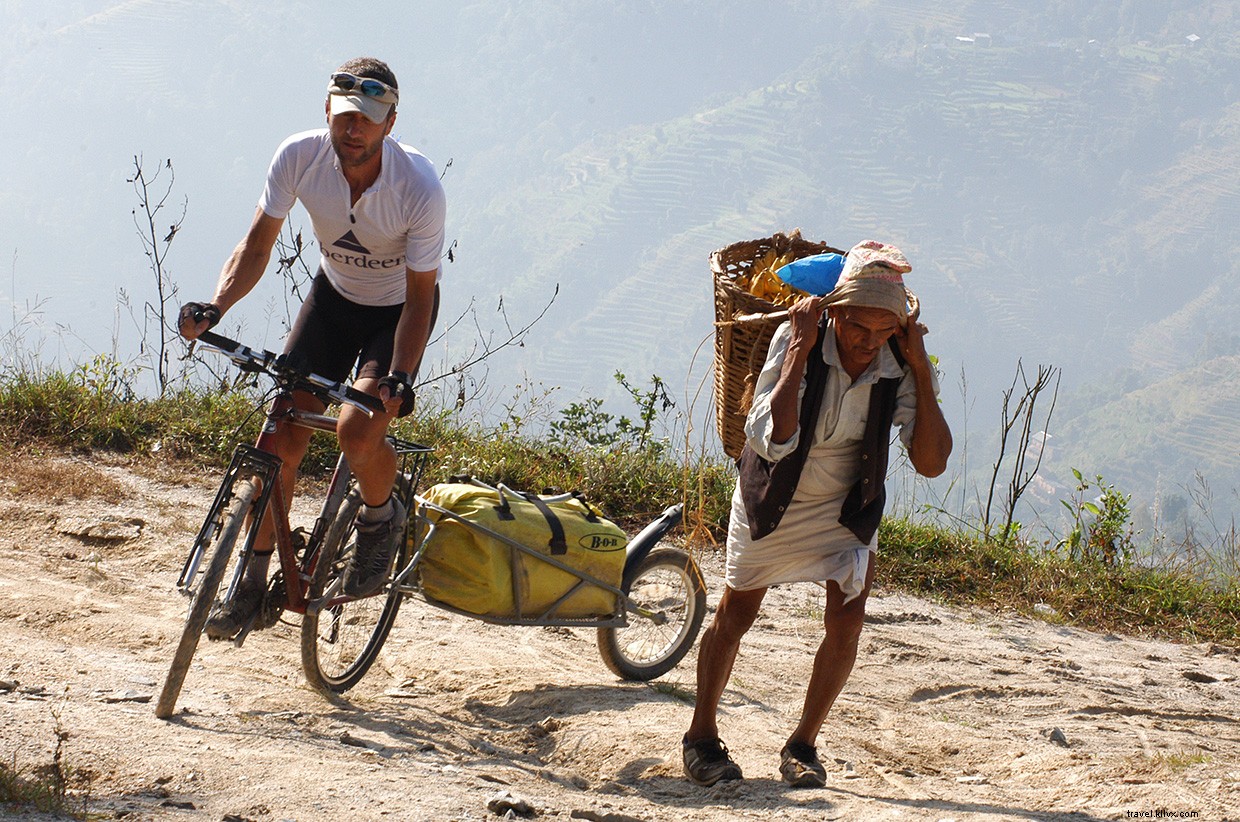
I crossed 37 countries, five continents, two oceans and one sea. I enjoyed the Muslim countries because their spirit of hospitality is very acute. Northern Sudan for example stands out; not a place you wouldn’t typically associated with a fun tourist destination. But I found the people of Northern Sudan to be absolutely brilliant, very congenial and hospitable. I never had to worry about where to buy food, or where I would get water from; people were always taking me in and insisting I stay with them.
That area of the Sahara, tracking up the Nile, is quite beautiful. It is obviously harsh, barren and stark as a desert but there’s lots of antiquity out there. The Sudan is a whole treasure trove of ancient artefacts; you’ll be riding along and you’ll come across a huge statue lying there in the sand that’s been there 3000 years. You really feel like an Indiana Jones, discovering something ancient for the first time.
That’s a good question. I think at the beginning I was 26-years-old and I was really into the idea of going out there and having a grand adventure. I was very much driven by adrenaline and the desire to go out there and test myself. To find out a little bit better who I was as a person. I think that’s something that all young people have, men and women, this desire to step out of their own cultural comfort-zone.
That was definitely my mindset when I set out from Greenwich, crossing the Atlantic, then crossing the USA on rollerblades. But then I was hit – I was hit by an 82-year-old drunk driver with cataracts in Colorado – and put in hospital for six weeks with two broken legs. I think that was the first time I had a big setback and I thought, ‘you know I’m not as invincible as I thought I was when I first set off,’ and these things are actually quite dangerous potentially.
The second third of the journey I became more interested in sharing the adventure with young people. So I ended up visiting 860 schools in all the different countries; working with teachers to develop curriculum, to take the expedition into the classroom as an educational tool. So that became my incentive to keep going after the thrill of adventure had worn off. The last third of the journey I had been going so long that by the time I finally reached Singapore, 11 years in, I was just trying to get the thing done. I was so sick of travelling by the end. I was just trying to complete this massive part of my life.
Euphoria, initially, because I hadn’t seen my family for so long, but then quickly followed by a terrible, crushing sense of anti-climax. Everything I had been doing for 15-odd years had been in some small or big way connected with heading west, even if it wasn’t actually travelling. Probably for every hour of travelling it took about two hours of fundraising, letter writing, or doing media stuff to pay for that, to make that one hour of travelling happen.
I think when I finished the journey it was like this sense of falling off the edge of a cliff. I had become the expedition and the expedition had become me. It had defined who I was as a person and when that finished there was this sense of the ground giving way underneath me. And it’s taken quite a long time to be able to re-assimilate myself back into society and part of that process that helped has been writing the books. It has been a necessary part of being able to move on from the whole thing and put it behind me.
That’s another good question. I think at the beginning I was extremely self-interested about having a huge adventure and I was driven by my sense of ego to go out there to try and conquer the world and plant a flag; you know, all the things we’re drawn to as young people.
But as I got into the expedition and I encountered so many mishaps and obstacles: the broken legs; spending a year for example travelling through Central and South America only to backtrack because of the El Niño effect in 1997 – that was a year wasted and 5000 miles in the wrong direction; pedalling on a spot for two and half weeks in a counter-current in the middle of the Pacific, that was the most soul destroying point of the whole expedition I think. And all the other things that happened that I couldn’t have foreseen at the beginning they kind of ground me down and after a while you realise that you never conquer nature, you have to work with her or she will obliterate you.
I do consider myself lucky to have survived that trip. I have come out of it with a lot of sharp edges to myself rounded off. I think I am more at peace now with myself and who I am, and I don’t feel the need to go out and prove myself again. Neither am I particular interested in spending any more time on a personal, spiritual journey, which was part of the whole thing for me. I am just really very happy to use my story to try and promote the concept of sustainability; I really think there is nothing more important for our generation than addressing this particular topic. If I can use my experiences and my work to now get people thinking about what I think is the most important subject of our time then hopefully I’m doing something useful with my life.
The award winning book, Dark Waters, part one of Jason’s trilogy documenting the expedition is available to buy here: billyfishbooks.com/Store
For more information on sustainability visit www.transitionnetwork.org or www.catamountinstitute.org