Uncharted Ice: A Solo Ski Expedition Across the Baltic Sea
The idea came from my friend José Manuel Naranjo: a Baltic Sea ski crossing, from Oulu (Finland) to Pitea (Sweden) completely unsupported – meaning without re-supplies en route or any external assistance. No fellow Spaniard had ever considered such a challenge before, and no one we knew had done it, so we started the planning stage with a huge amount of questions. Most of them would remain unanswered by the time we actually set foot on the ice.
The Harbour Master’s Offices in Sweden and Finland were clear on the matter: “We strongly discourage such a trip: there are ten main harbours, six icebeakers and over a hundred chargers operating in the Northern Baltic area.” Attached to the note was a rather dramatic picture of one of the mentioned icebreakers, followed by a troop of chargers capable of crushing the entire Baltic Sea with their keels. Under such conditions, the expedition would depend more on external factors than on the trip itself. Despite the warnings, there was no hesitation: we had decided to cross the Baltic Sea on foot in the dead of winter. Surely, we could have spared a lot of uncertainty by scouting the area from a chopper first, or maybe checking satellite images. However, that would have spoiled the spirit of it all, while we hoped to face the task ahead with a pioneer’s mind: setting off towards the unknown – with just patience, imagination and a strong will to carry on.
About 10,000 years ago, The Baltic Sea was a huge lake. Nowadays, a 4 km-wide gap connects it to the North Sea and the Atlantic Ocean. The Baltic has the lowest salinity levels on earth which, added to its northern latitude and extreme cold conditions in winter, keeps most part of its surface frozen solid for four or five months a year. Although it rarely freezes up completely, the remarkable conditions during the previous season led us to feel optimistic.
November and December 2002, plus January that year, were the coldest in the last 85 years, causing the ice to reach an unusual thickness. Sadly, as we soon discovered, the ice melted at an equally remarkable speed due to mild temperatures through February and March – the “warmest” in 40 years.
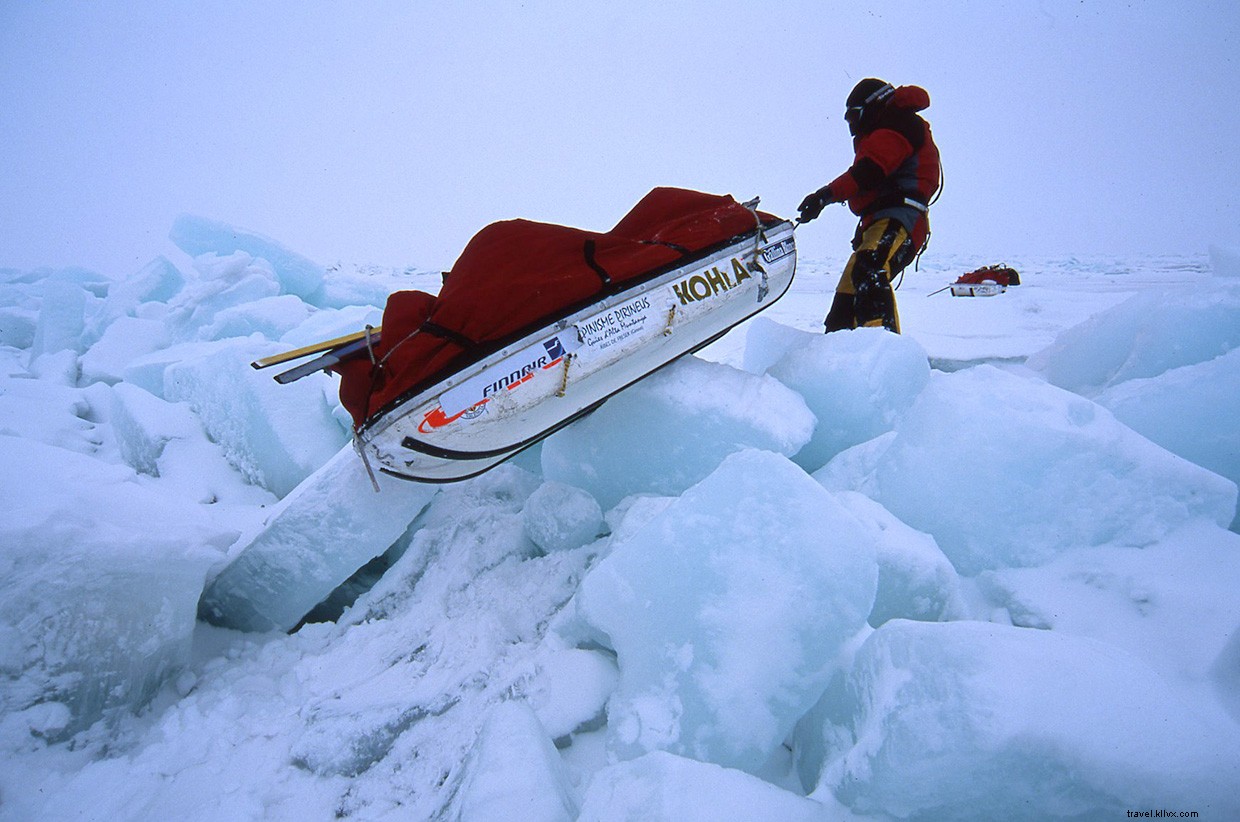
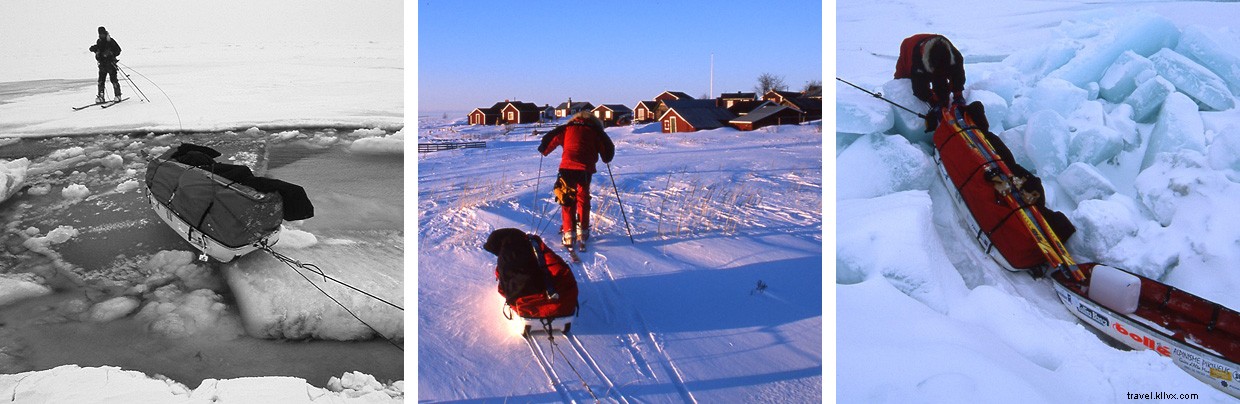
There was a lot we didn’t know by the time we departed from Oulu, Finland, on March 3, 2003. We carried gear and supplies enough for 15 days. Dragging our 80 kg-heavy pulks (sleds) right from the hotel’s gates, we walked down to the frozen beach, under the curious stares of a handful of locals. Jose Manuel carried a third, empty sled, meant to be used as a crossing boat on some of the numerous open water channels that we expected to find on the way. Should the open sea prove too wide, we could link our three sleds with the skis in order to improvise a trimaran boat. Resolution and imagination were our only resources as we set course towards Pitea, in Sweden, right across the sea by following Parallel 65º.
We started along Oulu archipelago on good, smooth snow. We even pushed on for a great deal of the night, hoping for a swift progress. We kept on our course by using several lighthouses on far-away islands, and continued across the sea, feeling more sailors than skiers… until we reached the first icebreaker trail.
These huge ships break their way through the ice, leaving behind a chaos of bulky ice blocks, ground ice and black open water. The resulting channels, 60 to 100 meters-wide, are impassable until they freeze up again. There was nothing we could do but wait, just as we did that first night. We waited for 4 hours, then pushed forward for a few more kilometers before setting up camp. After a much needed rest, we continued on excellent, firm ice, with some icebreaker routes well within sight.
Hailoto, the biggest island in Oulu archipelago, eventually disappeared from sight as we ventured further into the sea ice. The ice near land freezes up first and is thicker and smoother. Further into the sea, the ice suffers traumatic changes of temperature and state, and thus provides a much tougher and unstable surface. On the bright side, our emergency supplies had just been empowered by a handful of herrings, a present from some Finnish fishermen we had come across.
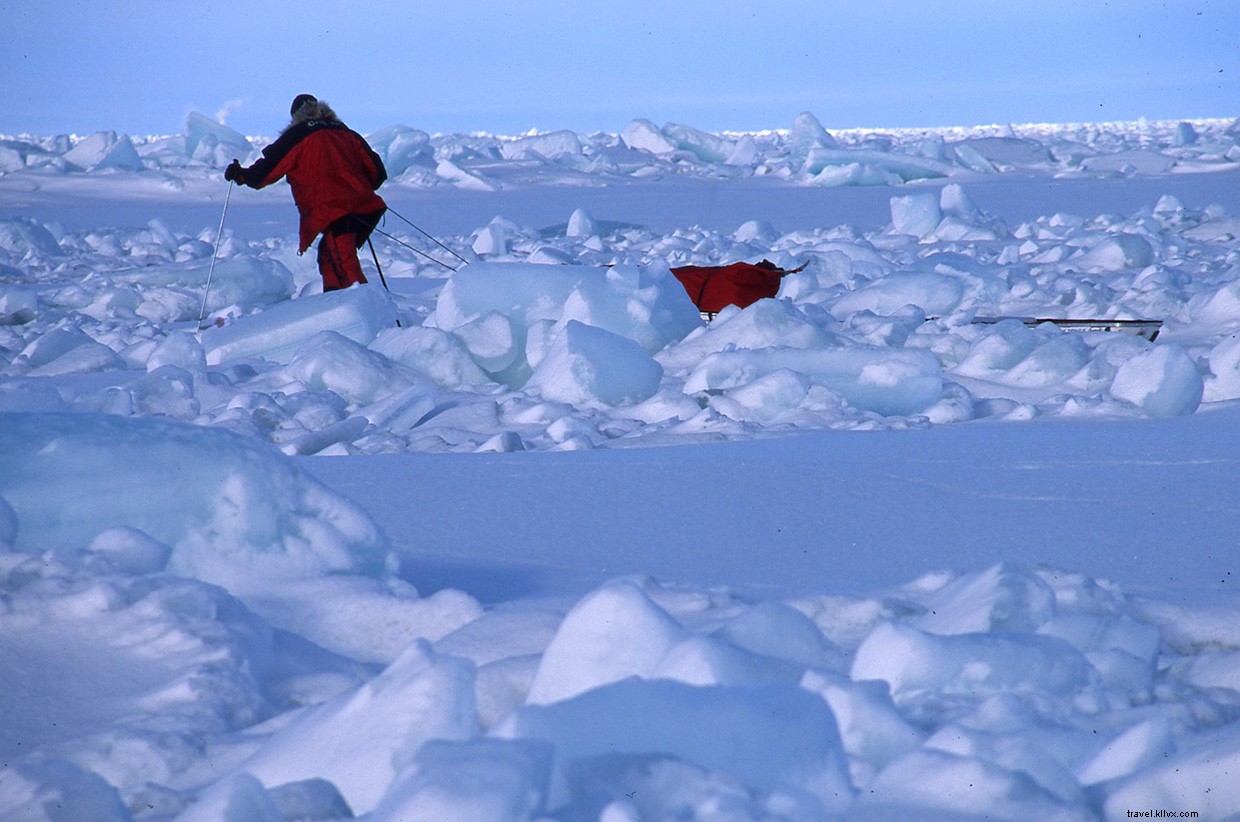
By sunset we encountered the first pressure ridges. We did our best to go straight ahead across them, although our route was never quite as straight as we wished. Progress ended up being a rough march up and down, around open water channels and patches of green, thin ice which we crossed with all possible caution and crossed fingers, hopping from a loose slab of ice to the next, feeling the ground sinking under our weight with every step.
One of the days, as we prepared to leave, the GPS indicated that we had drifted 1000 metres NW during the night. Unaware, we had camped on a gigantic iceberg which drifted along with the wind. As in a nightmare, I couldn’t help thinking on how the next pressure ridge could prove a dead end, with just black water ahead. We pushed on through each day with all our power, barely stopping for a break. Average temperatures in March are supposed to reach as low as -20ºc, but that year told a different story. We saw the ice melting under our feet while our thermometer registered as much as +7ºc.
On our sixth day, mid-way on the frozen sea, a huge phantom-like view suddenly appeared 500 meters behind us: it was a monstrous icebreaker, towing two freighters. Luckily, we had already crossed their course line. While I don’t think the crew in any of the ships spotted us, I’ll never forget the image.
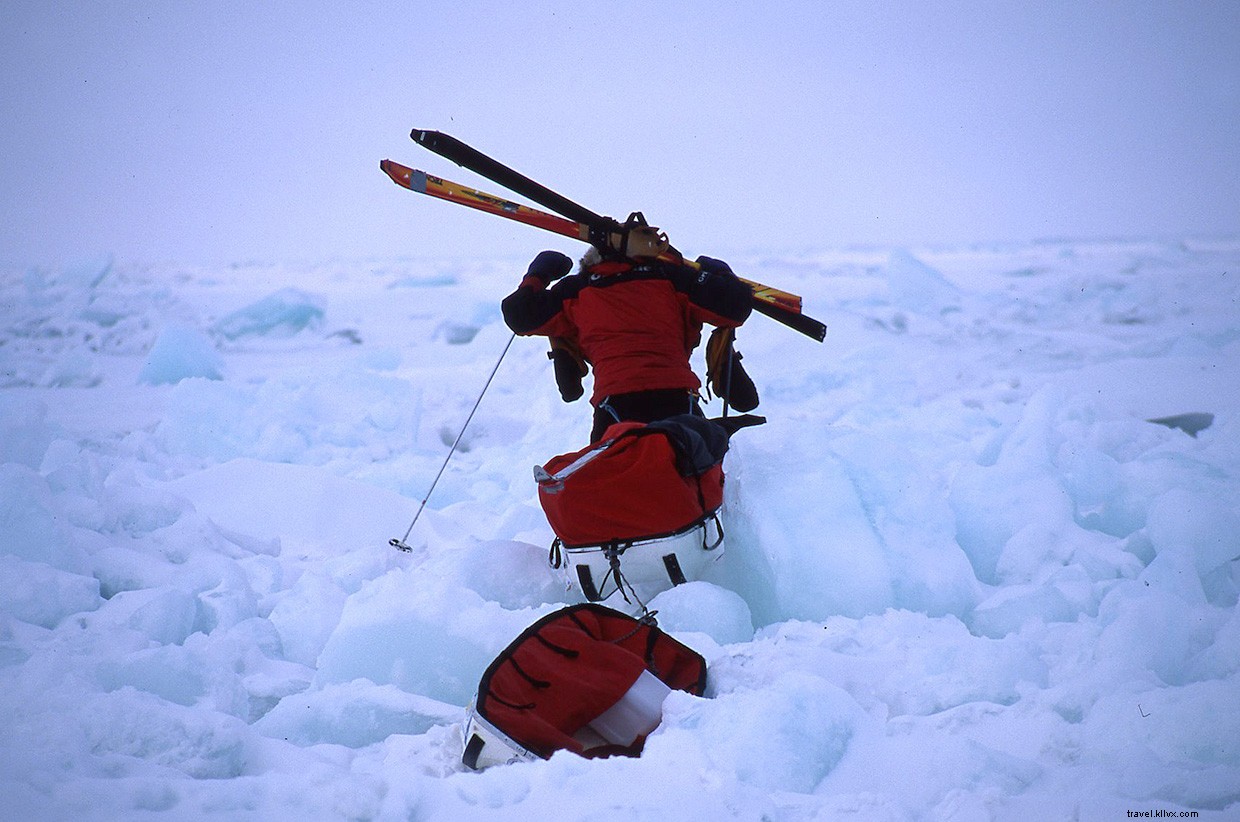
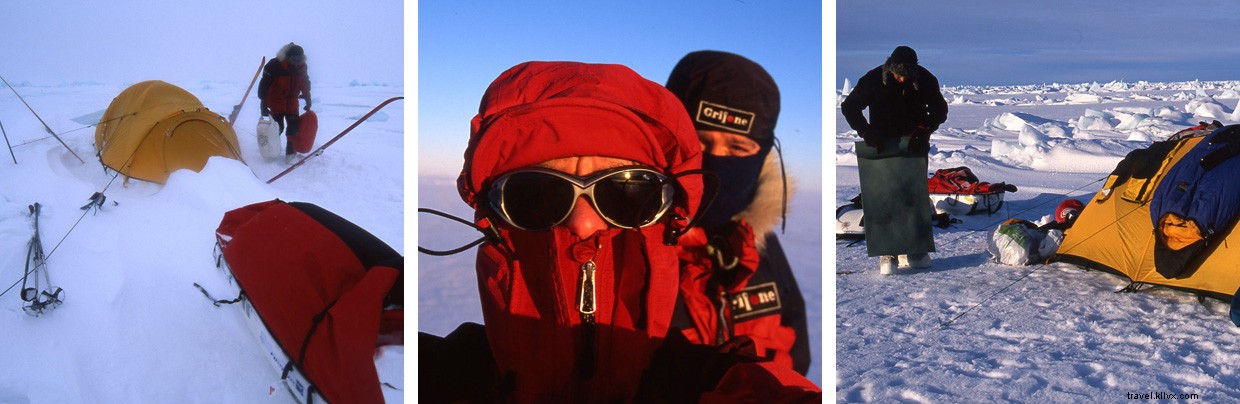
Despite the rough terrain and the unexpected obstacles, we eventually managed to adjust our pace, we learnt to move among the sea ice chaos and at some point, we actually started to enjoy it. At nights, we devoted ourselves to a new favorite sport: “stoving”. No wonder that, after a long day dragging the sleds along a barren surface with no possible shelter, we couldn’t wait to get as warm as possible. Therefore, once in the tiny tent we shared, we would turn on the stoves at full-throttle, in order to feel the temperature rocketing up to Finnish sauna levels.
The expectation of (very) warm evenings, thick soups and our personal version of “Baltic Gin cocktails” – consisting of oral saline solution and “tang” served steaming-hot, kept us going against the wind, cold, snow and rain storms, day after day.
Eskimos are said to be able to recognise ice conditions with a single glance. In that sense, we wanted to feel a bit like eskimos, evaluating blue and green ice as solid, the slab covered in a thin layer of snow as acceptable and the black one as disturbing to say the least. From time to time a certain block of ice, arisen and twisted by violent sea currents, permitted us to check its thickness, for better or worse.
Our penultimate day was cold and sunny, so that we seized the opportunity to dry our sleeping bag, sort out the chargers and brush everything clean of snow. We set off happy – as if we were the first men allowed to use a brand new world. After nine monotonously grey days, the sun was a gift that we cherished.
The terrain’s farewell souvenir was not so pleasant: we had to find our way through the biggest ice blocks we had faced in the entire trip. Through the day, our anguish increased along with the rising temperatures and our concerns about approaching ships. Eventually, our fears proved real: at 6:00pm, we crossed two water channels freshly opened by icebreakers. Beyond, a 400-meter wide flat slab ended up in yet another water way – 100 meters wide. There was no way to cross it on foot: our only option to reach the other side would be to assemble our sleds into a trimaran raft of sorts. It could float, sure, but… We were more than hesitant to use such an unstable resource, least of all among the numerous icebergs which floated in the open water. We would need an icebreaker of our own, and our home-made raft looked definitely far from it. A mild 0ºc temperature provided neither hope for the gap to freeze up again any soon.
There was nothing we could do but stop, rehydrate, rest – and think. We were trapped in a frozen slab, surrounded by three open water channels, right in the middle of an often-used icebreaker route. It was definitely not the best possible place to be. I guess that was what the Swedes had meant by considering our trip “inadvisable”.