Burning Man: A Fiery Desert Mirage of Art, Community, and Farewell
It's supporters and champions claim that Burning Man offers a little something for everyone. Even the means to say goodbye.
BLACK ROCK DESERT, Nevada – Nietzche has a parable about mortality: Everyone is busy building sand castles, he says, but some people notice that the tide is coming in. The day my father died, I all but drowned.
He'd written to me a few months before he passed away: "One day, when you have the time and inclination to travel again, head to some fervent Aztec wilderness. Take snaps of your dearly departed and immerse yourself in preparations to welcome the returning spirits with drink, food, and fine partying. Allow a week, don't hold back on your emotions, establish the Days of the Dead. You will leave happier, and a mite exhilarated."
For a long time after he'd stopped writing, and then talking, and then finally stopped his labored, cancer-riddled breathing, every day was a Day of the Dead. Sepia-toned, mortality drenched, paralyzed. The frenzied sand-castle building going on all around seemed obscene. But one year on, I found my very own Aztec wilderness at Burning Man. This extraordinary desert festival in Nevada offered me, and thousands like me, the perfect way to say a form of farewell.
Described as an experimental community built on radical self-reliance and radical self-expression, Burning Man is now celebrating its 25th birthday. By all accounts, including my own, it's in rude, rumbustious health. It began in 1986 when Larry Harvey spontaneously gathered a few friends on a San Francisco beach and burnt a six-foot wooden man. Legend has it he wanted to move on from a difficult break-up. As the ritual was repeated over the years, it grew too large for its beach origins and moved to Black Rock Desert in Nevada. In recent years, tens of thousands of participants have made the arduous journey from all corners of the world to contribute to and participate in the festival's unique temporary community: Black Rock City.
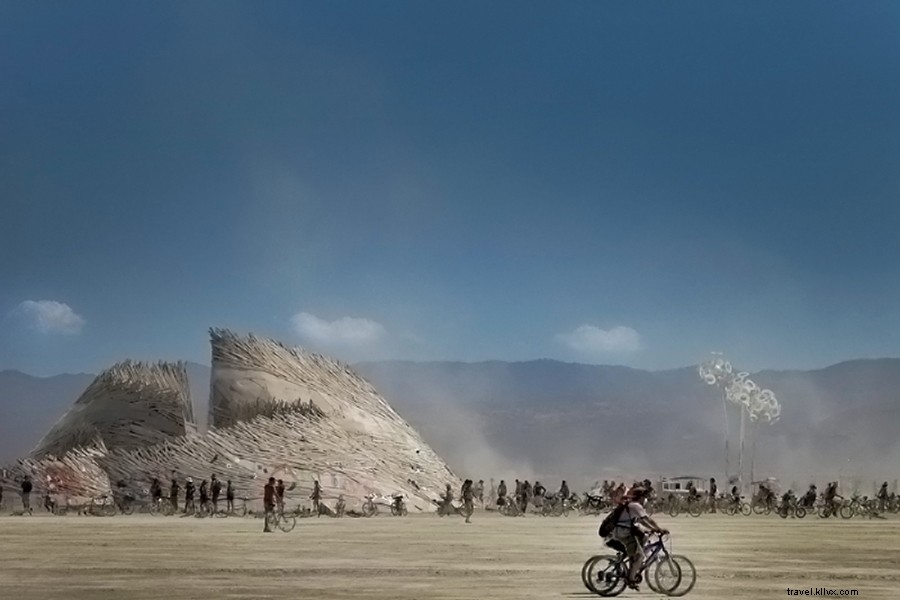
Arriving was distinctly Mad Max. The six lanes of desert track are filled with every form of vehicle parading into the festival, tires kicking up dragons of dust in their wake. It is a hostile place, as dry as you can imagine, temperatures soaring high into the 90s but, framed by the nearby mountains, it is hauntingly beautiful, desolate, flat white sand for miles around. The city is laid out in semicircular streets of makeshift camps, tents, geodesic domes, and RVs surrounding a large open area known colloquially as "the playa." The effect is one of a huge happy shanty town, back bared to the blistering heat. When the wind whips up dust storms, goggles and masks are essential, and the oddity of the enterprise hits home: 50,000 strangers are camped amidst hundreds of square miles of arid, ancient lakebed desert. It's the kind of place you'd film a car commercial rather than park up and camp out. The central circular playa is home to several hundred fixed art installations. The geometric focal point of the gathering is the Man, constructed of wood and steel, to be burned on Saturday night, in the culmination of the week-long festival. In 2010, he stood 104 feet tall, looking down beneficently on the community scattered widely around his feet.
Behind the Man, the Temple acts as a secular place of worship for the community, the festival's spiritual heart. Its unique frame is designed annually by a range of different artists, but it quickly becomes a user-generated church for Black Rock City. Within days, its surfaces are covered with contributions: memories and missives, letters and photos, wishes, angsts, new loves and old torments. On the final day the Temple too is burned, a more solemn, melancholy ritual than the hedonism of the previous night.
Everyone comes to Burning Man wanting to send something up into the sky. For Claire, the Irish drummer, in the RV parked to our left, it was a messy breakup with her band's commitment-phobic guitarist. For Matthew, camped on our right in his geodesic dome, it was the restraints of his shiny corporate tech job in Silicon Valley. For my brother and I, we were here to say a final goodbye to our father; or perhaps, more aptly, to say goodbye to our year of sticky, incapacitating grief.
As per my father's instructions, we had brought a few photos (his handsome WW2 mugshot and another where he brandished a bearded Ranulph Fiennes look in the 1970s). We shared a teary moment as we set up our little shrine amongst the thousands that were already there. We promised to visit the temple on a daily basis, but the call of Black Rock City was more than a match for our retrospection.
The festival's guiding aspiration holds that there are no spectators, only participants, and the range and depth of the contribution is breathtaking. Burners, as the participants proudly name themselves, bring and build everything. Nothing is centrally planned; art is everywhere, and the community generates all types of food, bars, clubs, and performance venues; there's even an airport and a local radio. The festival's famous gift economy — cash transactions are prohibited — transforms the city into a modern-day bartering bazaar and where offerings are showered on you by neighbors, and friendships are forged in a communal effort to beat the harsh elements and survive.
"Leave no trace" becomes another mantra for the week — everything brought into the city must be accounted for and removed after the festival finishes. (The site is subsequently tested by the Bureau of Land Management to an almost microscopic level.) Amazingly, despite its size, the care of the community and the work of an army of volunteers succeed in leaving the desert clean and empty, ready for the following year.
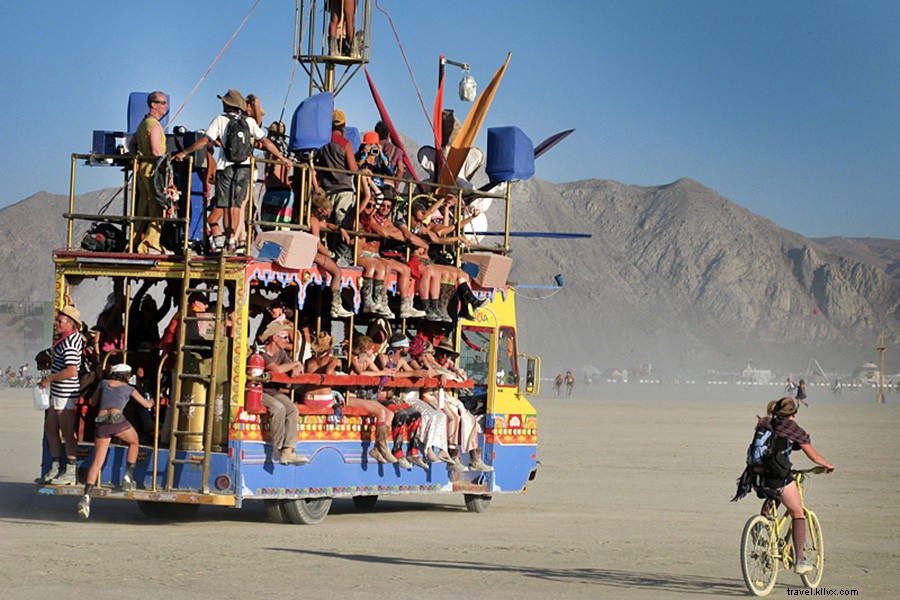
Cars (and guns) were banned in the festival's early years after a couple of nasty accidents, and glammed-up bicycles are the preferred mode of travel. Burners decorate your average two-wheeler exotically, often with neon flourescence to keep them visible after dark. Exceptions are made for vehicles designated "Art Cars" or "Mutant Vehicles." Nothing quite prepares you for the sight of a 60-foot pirate ship sailing gracefully across the salt pan, a huge dinosaur bedecked with dance floor, DJ and revellers, or a fleet of cream cakes skating in formation across the desert. Around every corner there are new sights to make you smile, and if you're lucky offer you a lift to a far-flung corner of the city. Costumes are extravagant, cater to all tastes and are, of course, entirely optional. Prudishness is not. Many Burners look like they've been naked since the sixties.
The days are filled with a unique tapestry of art, conversation, and, if your body can handle it in the exceptional heat, drinks. At night, some of the world's best clubs and DJs kick off and keep kicking 'til dawn. Thousands of bars (all free, but remember to bring your cup) do likewise. The minimalism of daytime costumes gives way to a carnival of fluorescence at night; as the desert temperatures drop, neon firs come out to play. And there is a lot of fire; fire everywhere. From flame throwers over the dance floor, keeping impeccable time with the bass, from a whole herd of mutant vehicles lighting up the night sky.
The evenings of revelry reach a climax on Saturday when the Man is burned. This is the focusing ritual of the week, 50,000 people gathered with hundreds of mutant vehicles to watch an extravaganza of pyrotechnics that builds to the burning of the Man himself. This pagan spectacle opens an evening that has as good a claim as any to be the best party in the world. The community that has bonded in this desert wilderness lets go together.
My brother and I thought that the burning of the temple on Sunday would be our apotheosis. The emotional release. The grand goodbye. But for us, as with so many Burners, we were burnt out by Sunday. We sat in an apocalypse of a different kind: the traffic queue headed out of the desert, and white, wobbly heat of an almighty hangover in a salt pan.
But as we looked back at the rapidly dissolving city in the oblong of vision of the rear view mirror, we realized that some kind of catharsis had happened, without our knowledge or planning. We'd helped raise an entire city from the expansive nothingness of the desert, helped and been helped by a sea of strangers bent on the same fleeting madness. We'd had a blast in the process. The whole project was so utterly and knowingly absurd, built with full knowledge of its own transience: looking straight into the heart of the approaching tide. We had done our conscientious best to leave no trace, dismantle our every creation, and the desert dusts were once again flat and empty with no sign of the Black Rock City sand castles that 50,000 revelers had raised. But what fabulous sand castles they were.