
Navigating Japan: A Practical Guide to Accessible Travel
The state of accessibility in Japan has improved dramatically in recent decades with a push towards "barrier-free" facilities that can be navigated by wheelchairs, non-step buses, multipurpose toilets and wide elevators with lowered buttons. However, there also remain a lot of challenges.
On the Streets
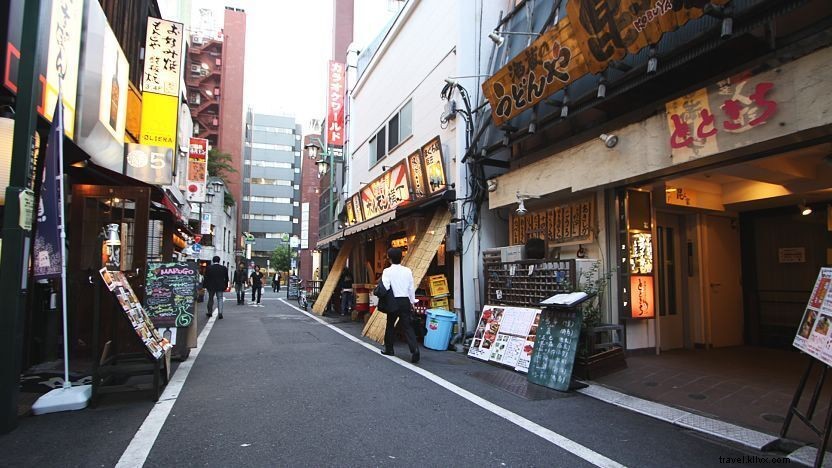
Streets in modern city centers and recently redeveloped districts tend to have relatively spacious, dedicated sidewalks with cut curbs. Elsewhere, sidewalks tend to be narrow or separated from vehicular traffic simply by a white line.
Older buildings in Japan tend to have narrow interior layouts. Consequently, shops and restaurants located in such buildings may be difficult to enter and navigate with wheelchairs due to the lack of space and presence of steps. Modern buildings and malls; however, tend to be highly accessible. Using a compact wheelchair will generally be an advantage to navigate Japanese cities.
Trains
Over the past decades, much effort has been put into equipping train and subway stations with escalators, elevators and stair lifts; but some stations - especially outside the city centers - remain difficult to use for travelers with mobility impairments. Also, at certain stations, only some of the entrances may be accessible, which may result in detours.
Most trains have at least one car with space for wheelchairs. When using trains, wheelchair users should approach the staff at the ticket gate. Station staff will guide passengers to the platform (some stations require the use of special, off-limit elevators), help boarding and disembarking using ramps, and call ahead so that there will be staff waiting at transfer points and the destination. When using long-distance and shinkansen trains, it is highly recommended to make a seat reservation for a wheelchair-friendly seat in advance.
Buses
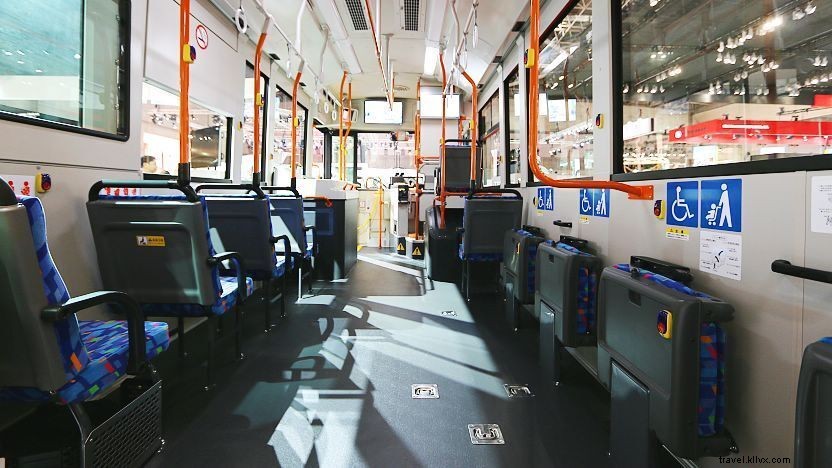
A majority of city buses these days are non-step or kneeling buses whose drivers will pull up as close to the curb as possible and get out a ramp for wheelchair users. The priority seating area on city buses may have a combination of foldable seats and/or a section without seats for wheelchairs. However, in smaller cities and in the countryside, it is still possible to encounter some older type buses that are difficult to use with a wheelchair.
Long distance buses and airport buses, on the other hand, tend not to be as accommodating to wheelchair users, because boarding typically involves climbing multiple steps. It is usually possible to ride one, but it may require prior arrangement.
Taxis
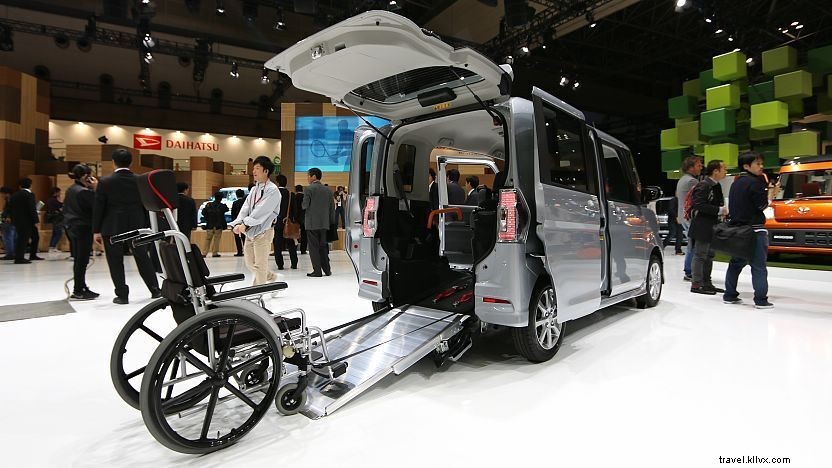
Taxis with wheelchair ramps or special seats that rotate outwards for easier boarding have been increasing considerably in recent years. However, many taxis are not yet equipped with ramps and may be difficult to board. While a folding wheelchair will fit easily into a regular taxi's trunk, non-folding ones will probably not.
Rental Cars
Many car rental outlets offer wheelchair-accessible vehicles known in Japanese as fukushi sharyō (�����ԗ�). Their prices do not differ greatly from hiring a similar sized, regular vehicle. Note that most car rental companies list their wheelchair-accessible vehicles on their Japanese websites, but not on their English ones. Consequently, a phone call will be required.
Toilets
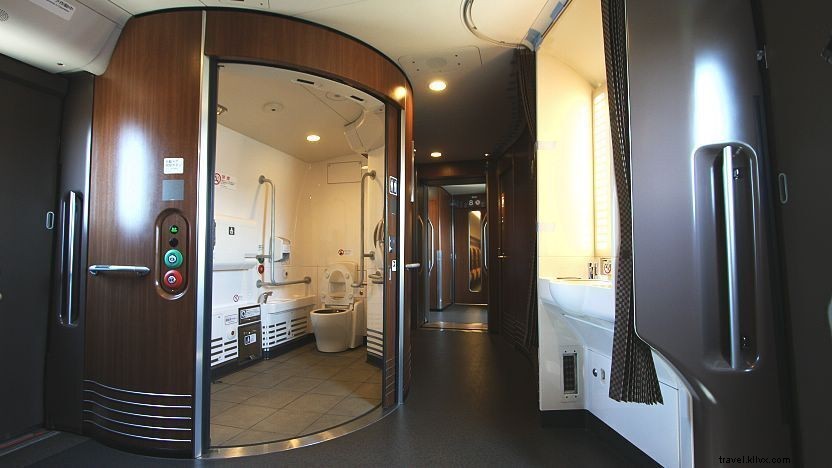
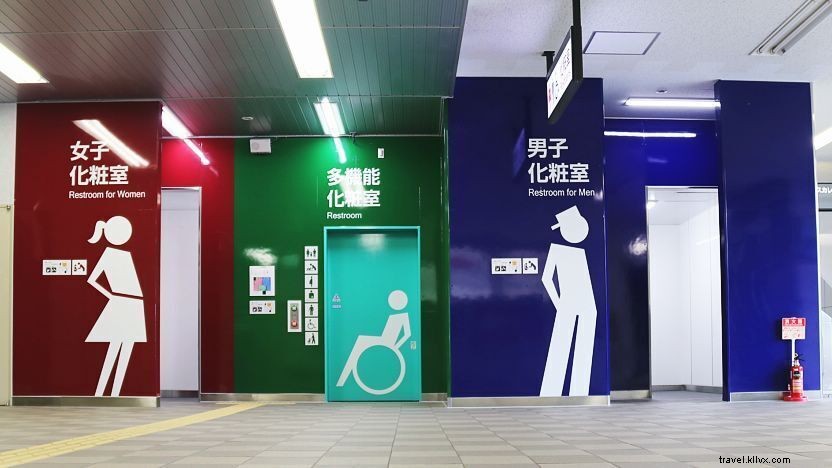
With the push towards universal design, the layout of toilets has also changed. These days, it is common to see multipurpose toilets (���ړI�g�C��, tamokuteki toire) at tourist attractions, department stores, train stations and inside shinkansen trains.
These multipurpose toilets are typically found between the men's and women's toilets and are usually large, single rooms that are easily navigable by wheelchair users and sometimes also feature ostomate facilities. They are also intended for parents with young children and therefore also often feature diaper changing tables. Opening and closing the doors can be done by pushing large buttons by the side of the door both inside and outside the toilet.
Sightseeing & Accommodation
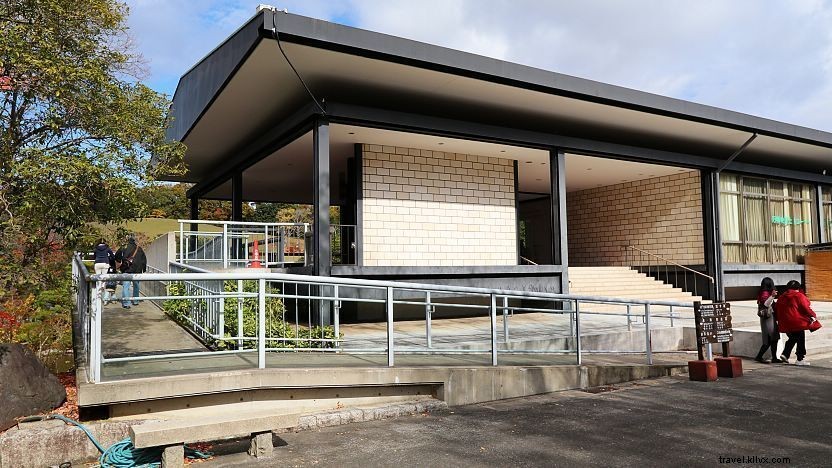
Accessibility of historic and cultural sites has been improving with the addition of ramps and lifts to existing structures; however, there remain some sites where upgrades are impossible. Newer tourist sites have to include universal design into their construction and tend to be highly accessible. While there is ample of sightseeing information for wheelchair users in Japanese, detailed information in English is less plentiful (see external links below for some good English websites).
Similarly, new hotels have to be accessible by law, while older hotels are undertaking renovations to include barrier-free designs. Some lodgings offer specific barrier-free rooms with bathrooms that cater to those with mobility issues, but these are typically limited in number. As with tourists sites, finding English information about the accessibility of lodgings can be challenging.
Visual impairment
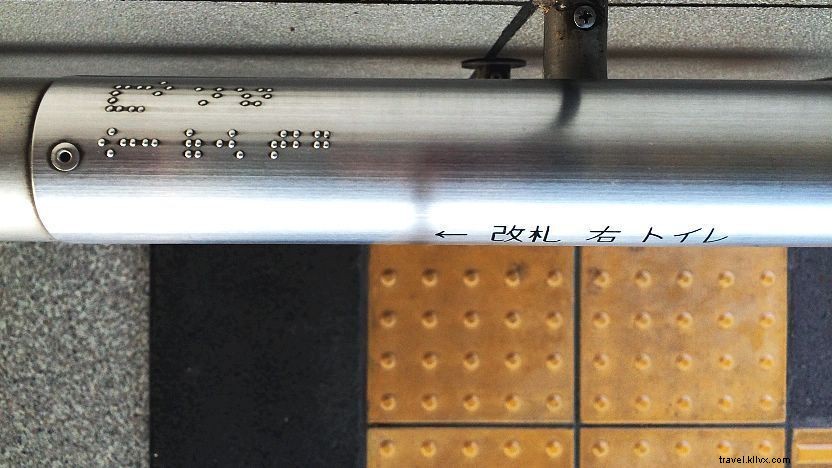
Yellow tactile paving is ubiquitous in Japan. Likewise, there is a lot of information in braille found in public facilities, on board of trains and printed onto some packages; however, the information is in Japanese Braille which is based on Japanese syllabary.
Furthermore, sounds play a large part in helping the visually impaired move around. Various repeating sounds and announcements in stations and other public facilities are played near exits, toilets and braille maps to help improve orientation in conjunction with tactile blocks. Audible signals at some traffic lights indicate that it is safe to cross the intersection.