Archaeologists Uncover Evidence of Plantation-Era Smokehouse at Gascoigne Bluff
One entire wall of the plantation-era tabby structure was covered in grease, but archaeologist Marie Meranda suspected more than poor 19th-century housekeeping.
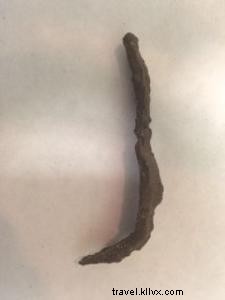
When her team uncovered a meat hook during a recent dig at Gascoigne Bluff, it provided a crucial clue.
“I’ve worked in this field for years, but I’ve never seen a meat hook,” Meranda explained. “It’s highly specialized equipment. This strongly suggests we’ve found a smokehouse.”
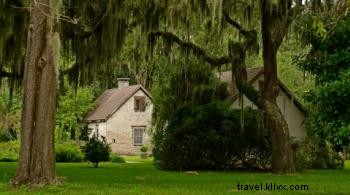 This potential smokehouse emerged as the most significant discovery from a two-week excavation near the tabby slave cabins at Gascoigne Bluff on St. Simons Island. Other finds included Native American pottery, china, pipe stems, and handmade nails.
The Coastal Georgia Historical Society sponsored the dig ahead of a drainage pipeline for the Mariners Landing townhouse community under construction at Hamilton and Sea Island roads.
Glynn County authorized the team to collect shovel samples every 5 to 10 meters along the 600-foot pipeline route from Arthur J. Moore Drive westward to the Frederica River.
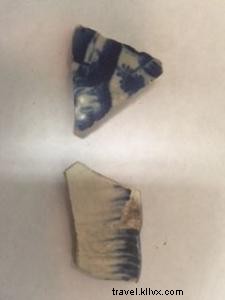 The team located a tabby foundation corner between the preserved slave cabins and Epworth by the Sea’s Strickland Auditorium. Its importance prompted county approval for expanded investigation, Meranda noted. Nearby, they found wall remnants, plain utilitarian ceramics, and the meat hook, with grease throughout.
“We discovered a wall collapse with greasy, charred material,” said Meranda, a postgraduate intern with the society. “The ceramics were purely functional, and the thick, tar-like grease supports the smokehouse theory.”
This structure belonged to Hamilton Plantation, active from the 1790s through the Civil War in the 1860s. Smokehouses were essential for meat preservation before refrigeration. The foundation measured 11.5 by 10 feet.
Little documentation exists on Hamilton Plantation, with no surviving layout maps, according to Janis Rodriguez of the Cassina Garden Club, which maintains the two historic slave cabins—the only above-ground remnants.
 “;I wasn’t expecting any finds, so this was thrilling,” Meranda said. “I’m excited to contribute new insights into Hamilton Plantation.”
Other artifacts came from shovel tests elsewhere but didn’t justify further excavation. All items require cleaning, dating, and analysis, Meranda added.
Per the agreement, all artifacts become Glynn County property for display in local libraries and museums.
“;St. Simons Island boasts a rich cultural heritage, and documenting it is vital for future generations,” Meranda emphasized.
Written by Larry Hobbs, The Brunswick News, Published 11/4/2015.
Photos provided by the Coastal Georgia Historical Society.