Discover Authentic Burmese Cuisine: A Guide to Eating in Myanmar (Burma)
Burmese cuisine often gets an undeserved bad reputation. While it can be richer and less spicy than neighboring Thai food, with some guidance, you'll discover flavorful, memorable meals throughout Myanmar.
A Traditional Burmese Meal
T’ămìn (rice), also known as htamin, forms the heart of every Burmese meal. It's paired with diverse dishes reflecting Burmese, Mon, Indian, and Chinese influences. These feature local plant- and seafood-based ingredients, balancing sour, salty, spicy, and bitter flavors typical of Southeast Asian cuisines.
The joy of a genuine Burmese meal lies in its variety, rivaling even Thai feasts. At a Myanma saa thauk sain (Burmese restaurant), select a curry, fried dish, or salad, and enjoy an array of sides. Expect soup—like Indian-inspired peh-hìn-ye (lentil soup with vegetables) or tangy hìn-jo (sour soup)—plus fresh and par-boiled vegetables with dips such as ngăpí ye (fishy dip) or balachaung (chili, garlic, and dried shrimp fried in oil). Unlimited green tea, vegetable sides, and dessert of pickled tea leaves with jaggery (palm sugar) complete the spread.
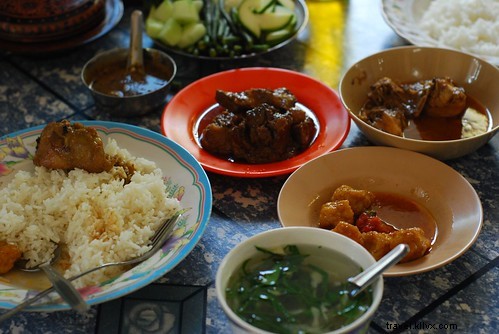 Rice, curry, and sides by magical-world. Creative Commons BY-SA license.
Burmese Specialties
Standout dishes include ăthouq—refreshing salads of raw vegetables or fruit tossed with lime, onions, peanuts, roasted chickpea powder, and chilies. Favorites are maji-yweq thouq (tender tamarind leaves) and shauq-thi dhouq (indigenous lemon). Burmese creativity shines in salads like t’ămìn dhouq (savory rice salad) and nangyi dhouq (thick rice noodle salad).
The iconic leq-p’eq (fermented tea leaf salad, or laphet) mixes slimy green leaves with sesame, fried peas, dried shrimp, garlic, peanuts, and more. Though off-putting at first glance, it's delicious. Try the milder leq-p’eq thouq with tomato, cabbage, and lime—a popular caffeine-boosting snack for students.
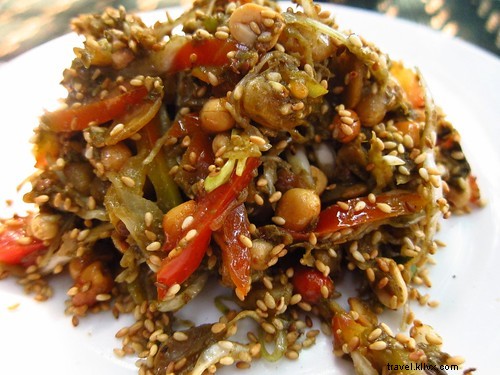 Leq-p'eq (tea leaf salad), Bagan, by fabulousfabs. Creative Commons BY license.
Noodles, called hkuauq-swèh, are beloved for breakfast or light meals. The national favorite, moún-hìn-gà (mohinga), features thin rice noodles in fish-shallot broth topped with crispy fritters. Móun-di (mondhi) offers spaghetti-like noodles with chicken or fish, while oùn-nó hkauq-swèh brings coconut milk broth with chicken noodles.
Regional & Ethnic Variations
Cuisine varies: lower Myanmar (Yangon and delta) favors fish pastes and sour dishes; upper Myanmar (Mandalay) emphasizes sesame, nuts, and beans.
Around Mandalay and Inle Lake, Shan cuisine resembles northern Thai food. Try k’auq sen (curry rice noodles) and meat salads, plus maung jeut (rice crackers).
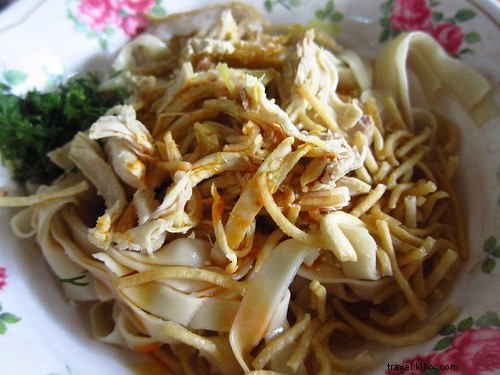 Shan noodles by fabulousfabs. Creative Commons BY license.
Shàn k’auq-swèh (Shan noodle soup) with chili-marinated chicken or pork is widespread, especially in Mandalay. Myi shay is a Mandalay variation with pork, and ngà t’ămìn jin (kneaded fish rice) adds turmeric flair.
Mon cuisine (Bago to Mawlamyine) mirrors Burmese but boasts more curries with extra spice. Rakhine (Arakan) food echoes Bengali styles with beans, spicy curries, and flatbreads.
Chinese restaurants offer Burmese twists on classics, though they're common but unremarkable outside cities. Indian spots, especially in Yangon, serve stellar dan-bauq (biryani) and vegetarian thali at 'Chitty' eateries.