From the nation’s second city to the museums and archaeological splendor of Vergina, Pella, Dion and Philippi, northern Greece offers a rich panorama of fascinating historical destinations.
Thessaloniki
These days, the “jewel in the Macedonian crown” is Thessaloniki, originally a Hellenistic city founded by Cassander some 2,300 years ago. It was the third capital to be established, after Aigai and Pella, as the ancient Macedonians continued to seek ever-better access to the sea – an important highway for naval, commercial and civilian transport.
Strategically located on the coast and astride a major east-west land route, Thessaloniki was coveted and/or conquered by the Romans, Byzantines, Crusaders, Ottomans, Bulgarians and Greeks. Periods of both great success and repeated hardship mark the long history of this port city, which was finally annexed by Greece in 1913.
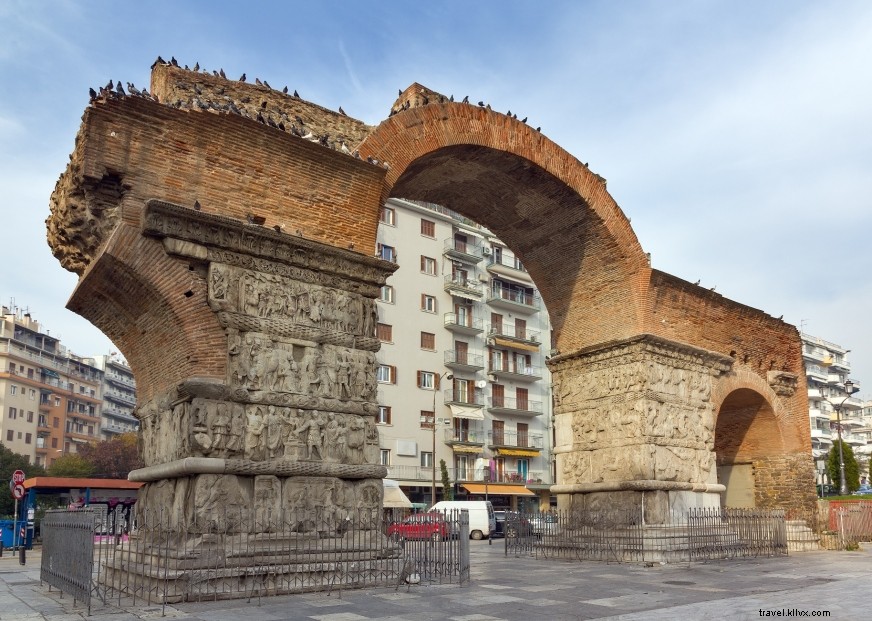
Today, historic monuments, museums and inscribed memorials shed intriguing and sometimes disturbing light on Thessaloniki’s rich, multi-ethnic past. Roman life and imperial rule are brought to mind by the archaeological traces of the main marketplace (agora) and Galerius’ once-lavish palace, while Byzantine and Ottoman times are recalled in the city’s towers and defensive walls, domed mosques and public baths, as well as in the splendidly decorated churches and narrow, twisting lanes of Ano Poli (the Upper Town).
At the Archaeological Museum of Thessaloniki (AMTH) and the Museum of Byzantine Culture, visitors will find excellent thematic displays that cover prehistoric times, ancient daily life, the rise of cities and imperial dynasties, religious worship and funerary customs. Mosaics, sculptures, gold artifacts, elegant icons and decorative elements from Early Christian churches are just some of the highlights. Reminders of Thessaloniki’s once-thriving Jewish community are preserved among Roman-era sarcophagi outside AMTH, at the Jewish Museum and at key spots around town.
Lefkadia, Mieza
In the area of Lefkadia and Kopanos are four fine examples of aristocratic, “Macedonian-type” chamber tombs. These multi-roomed, subterranean family crypts, accessed by ramps, were constructed of limestone blocks with barrel-vaulted roofs. Their stucco facades and colorful frescos are distinguished by an eclectic style assembled from various Classical elements, designed as a tribute to Greek domestic and temple architecture, mythology and history.
The two-storied Tomb of the Judgment (325-300 BC) had four Doric half-columns flanking its entrance, with metopes depicting the Centauromachy. Painted between the columns was the deceased Macedonian noble’s descent to Hades, escorted by Hermes and overseen by two judges. Above, there was an Ionic frieze showing Greeks/Macedonians fighting barbarians/Persians, six Ionic half-columns and a triangular pediment.
The Tomb of the Palmettes (300-250 BC) featured an Ionic façade with a polychrome entablature and pediment, and large palmette antefixes adorning the roof. The antechamber’s ceiling was frescoed with more palmettes, water lilies and twisting tendrils, perhaps an allusion to the underworld landscape of Lake Acheron.
The contemporary Kinch Tomb contained a fresco of a Macedonian knight spearing a Persian soldier, while the interior of the Tomb of Lyson and Kallikles (200-150 BC) was painted with fourteen seemingly 3-D Ionic piers, draped garlands, armor panoplies and Macedonian shields, all in green, red, blue, brown and black.
At nearby Mieza, the so-called School of Aristotle (Nymphaion) occupied a cave complex beside a shady river, augmented with a pi-shaped Ionic stoa. Philip sent Alexander here to be tutored by Aristotle, beginning about 343 BC.
Aigai (Vergina)
A unique cultural monument not to be missed is the archaeological site and museum at Aigai (Vergina), the original Macedonian capital. Aigai’s small theater was already notorious in antiquity as the scene of King Philip II’s shocking assassination in 336 BC by his resentful ex-lover Pausanias. Although this was an ignoble end for a great king and highly successful military commander, Philip’s “fast” lifestyle, overweening arrogance and abrupt fall at Aigai opened the way for his soon-to-be “Great” scion, Alexander III.
Aigai also served as a royal burial ground, where the largest tumulus, excavated by Manolis Andronikos in 1977, was found to contain the lavishly interred remains of (many believe) Philip II. Specialists agree this mound, now restored above one of Greece’s most impressive museums, was the final resting place of Philip and of Alexander the Great’s son, Alexander IV; however, as with all archaeological narratives when analyses are completed and further data become available, Philip’s story today is taking on fresh complexity.
As scholars continue debating, they leave us with intriguing questions. Was Philip buried in Tomb II or next door in Tomb I? If Philip is not in Tomb II, is it possible that its occupant was his son, Philip III Arrhidaeus? Was the ambitious Cassander behind the elaborate burials of Tomb II, perhaps even including Alexander’s personal armor to signify a definitive end to the Argaead dynasty and the launch of his own Antipatrids? However the mystery may ultimately be resolved, Vergina’s extraordinary museum captures all the dramatic essence of what it meant to be an ancient Macedonian.
see full article here